
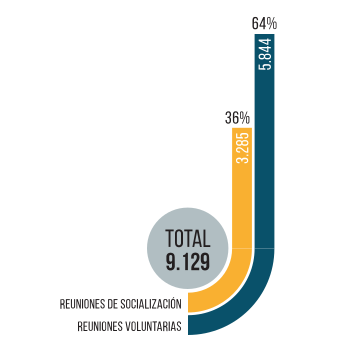
The relationship scenarios correspond to voluntary meetings and socialization with interest groups; that is, with local, departmental, national authorities, representatives of communities and their representatives, Community Action Boards (JAC), social organizations, unions, chambers of commerce, supplier associations, among others. In the last year, more than 9,000 relationship spaces were held, 64% were voluntary meetings and the remaining 34% were socialization meetings, mainly in the departments of Casanare, Tolima, Putumayo, Meta, and Antioquia; that is, on average, about 25 meetings are held daily in the operating regions.
Now, of the total of these scenarios, 64% were voluntary meetings and the remaining 34% were socialization meetings.

As observed in graph 21, in the departments of Casanare, Antioquia, Putumayo, Santander, Cesar, Nariño, and Tolima, voluntary meetings were developed in greater proportion. Meanwhile, in Meta, Boyacá, and Huila, it was the regions where more socialization meetings were held.
In addition to these relationship spaces with interest groups, companies also have mechanisms such as the Questions, Complaints, and Claims (PQR) systems, which allow for the exchange of information by different actors and resolve any concerns that may arise around the activity. These spaces not only allow for permanent communication channels but also channel issues that can materialize into blockages to operations. Active Listening communication programs, among other strategies within the framework of Social Responsibility policies, are also developed to generate both dialogue spaces and participatory management of interest groups.

 Colombian Association of Oil and Gas
