
Generating and maintaining trust relationships with stakeholders is one of the main aspects to ensure the development of operations. Each year, companies define strategies that allow them to have a constant, open, and transparent dialogue with their stakeholders, so that they can define joint actions for coordination or resolve any conflicts that may arise.
The industry creates relationship spaces from its arrival in the regions, within the framework of due diligence. Many times, this relationship occurs before the presence of the State, a fact that the industry has emphasized as a difficulty. The development of these spaces is accompanied by mapping the stakeholders that are part of the operational areas, with the aim of defining an action plan that allows not only identifying who the actors present in the region are but also what their interests, concerns, and considerations regarding the sector are.
The development of these spaces is accompanied by mapping the stakeholders that are part of the operational areas, with the aim of defining an action plan that allows not only identifying who the actors present in the region are but also what their interests, concerns, and considerations regarding the sector are.
Indeed, the relationship with stakeholders involves, in addition to their recognition, identifying what their relationship with the company is, how they may or may not be impacted by the activities, and how their interests align or conflict with the sector's objectives. The above is with the firm purpose of having a good relationship with these stakeholders and conducting due diligence in managing the impacts derived from the operation.
Generally, this relationship is generated more easily with those stakeholders that are directly related to the activity, such as employees, local suppliers, and local and regional authorities; but it is also necessary to generate a relationship that involves creating stronger bonds of trust and a permanent dialogue with communities and other groups, in order to reduce conflicts of interest and establish a common work agenda.
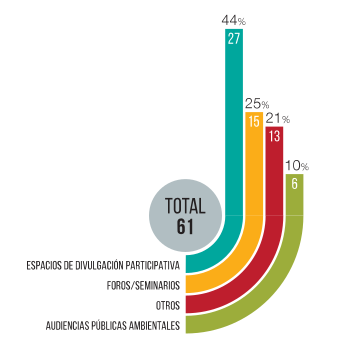
Likewise, companies create different spaces for the dissemination of information. Primarily, they have an active participation in information dissemination scenarios, public hearings, forums or seminars, and others such as meetings with community leaders and local authorities.
The development of these spaces indicates that companies have a firm commitment to keep the population constantly informed about the development of their activities, the focus of their social investment, the impacts of the activities, generating sensible and transparent dialogues.
In general terms, during 2016, companies informed stakeholders in voluntary socialization or relationship meetings mainly about the execution of social investment resources (19%), the development of activities and their impacts (19%), and environmental compliance as required within the environmental licensing process (19%). Likewise, they disseminated information about corporate policies (17%), the results of spaces with local, departmental, and national governments (15%), the progress of commitments made with certain actors (7%), and other topics that are relevant to stakeholders (5%).

Dialogue spaces with stakeholders
While companies tend to develop different dialogue spaces with stakeholders, these can be classified into two main scenarios: relationship spaces and intercultural dialogues.
Regarding the relationship spaces with stakeholders, they mainly refer to socialization meetings and voluntary meetings. Specifically, socialization meetings are focused on disseminating technical, social, and environmental information about activities during the different stages of operation.
The development of these spaces is not only important as part of the environmental licensing process but also because they are the scenarios through which specific and verifiable information is provided to the community about the real impacts of activities and how the company and the sector work to correct, mitigate, prevent, and compensate for them.
On the other hand, voluntary meetings are all the spaces that take place between the company and stakeholders, in which topics of relevance for both communities and authorities as well as for companies are addressed. Usually, in these spaces, topics related to expectations regarding labor aspects, social investment, and the purchase of goods and services are discussed.
Now, the second relevant relationship scenario is intercultural dialogues with ethnic groups. These spaces are mainly focused on the relationship with the different ethnic groups found in the areas of influence of the projects.
 Colombian Association of Oil and Gas
