
One of the stakeholder groups that companies in the sector interact with are ethnic groups (indigenous, ROM, or Afro-Colombians) that are present in the areas of influence of the projects. Two types of engagement are carried out with these groups: on one hand, there are the spaces within the framework of the Prior Consultations and on the other, the scenarios that are developed voluntarily.
The engagement that takes place within the framework of the Prior Consultations is carried out according to what is defined in the current regulations, which in the Colombian case is the ILO Convention 169, Law 21 of 1991, and Presidential Directive No. 10 of 2013.
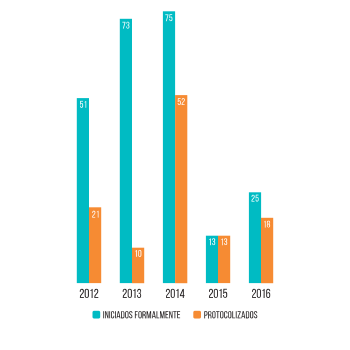
According to the information obtained for this report, the 18% of the companies carried out prior consultation processes in 2016. Specifically, during that year, 25 prior consultation processes were formally initiated, of which 72% were protocolized in the same year.
Compared to previous years, 2016 shows an increase of almost 50% compared to 2015, but a decrease compared to 2012, 2013, and 2014, years in which 51, 73, and 75 prior consultation processes were initiated, respectively. However, when observing the proportion in the protocolization, there is an improvement in the protocolization times in 2015 and 2016 compared to previous years; evidence of this is that in 2013 only 14% of the initiated processes were protocolized, while in 2016, 72% of the formally initiated consultations were protocolized. This demonstrates greater effectiveness and relevance of the processes carried out by government entities, companies, and communities.

As a result of these prior consultation processes, during 2016, 14 compensation projects were advanced, mainly focused on strengthening ethnic organizations (21.4%), conservation and strengthening of cultural identity (21.4%), housing infrastructure (21.4%), educational strengthening (14.2%), training in productive projects (14.2%), and land acquisition (7.14%).
However, it is important to keep in mind that the industry not only interacts with ethnic communities within the framework of prior consultation processes but also engages in intercultural dialogues voluntarily and permanently with the communities present in their operational areas.
As in previous years, companies developed different voluntary engagement projects independent of the prior consultation processes. Specifically, during 2016, 62 investment projects were carried out, which represents a significant increase compared to 2015, 2014, and 2013, periods in which 28, 49, and 55 projects were carried out, respectively.

When observing graph 24, and as evidenced in the compensation projects, companies focus their efforts on developing programs that strengthen community organization; in 2016, 44% of the voluntary projects had this focus. On the other hand, 16% of the projects were in conservation and strengthening of community identity, 15% for the development of housing infrastructure, and the remaining 26% were focused on training for productive projects, community strengthening, and other projects such as sanitation and food security.

These projects were carried out in the departments of Putumayo, Córdoba, La Guajira, and Meta. In total, more than 20,000 members of ethnic communities benefited, mainly indigenous and Afro-descendant communities. The largest number of beneficiaries was in La Guajira with nearly 18,000 people.

In the last five years, ethnic communities have benefited from more than 260 investment projects that have mainly promoted the strengthening of community organization. The sector's efforts have focused on preserving the culture and identity of ethnic communities as an intangible heritage of the country.
 Colombian Association of Oil and Gas
