
The hydrocarbon industry: energy and economic pillar of Colombia
Energy is the backbone of national development. Without energy security, there is no economic growth, fiscal stability, or social welfare.
In Colombia, oil and gas are not just natural resources; they are engines of investment, employment, fiscal revenues, and opportunities for the regions. They are the pillar of national energy security: they represent 63.1% of final energy consumption, 25.1% of the installed generation capacity of the National Interconnected System, and 99.61% of energy consumption in the transportation sector. They are essential to ensure stability, reliability, and autonomy in energy supply.
Since the discovery of the La Cira Infantas well in 1918, the hydrocarbon industry has experienced moments of boom, stability, and crisis, due to exogenous and internal causes. However, the triad of communities – Government – companies has allowed its development for the benefit of all Colombians.
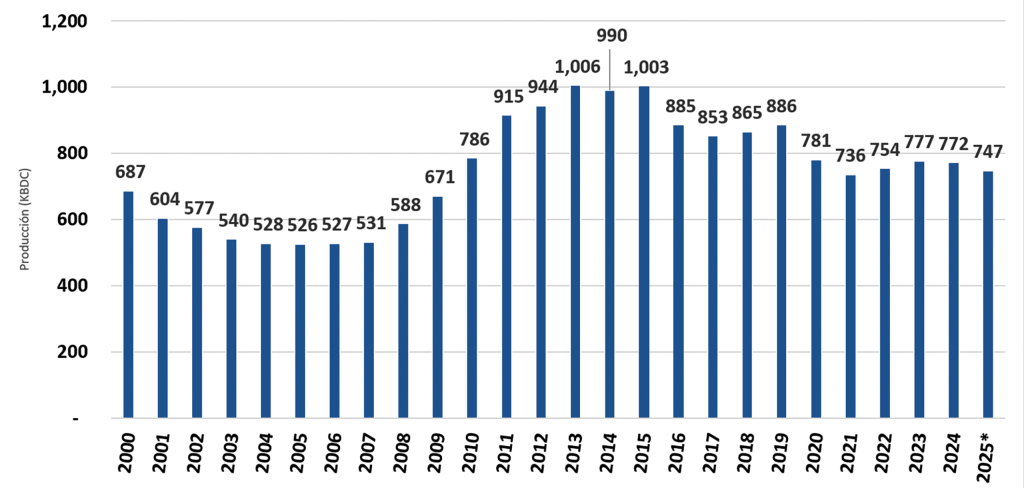
Between 2012 and 2014, after a period of relative stability in production, the greatest milestone in Colombia's history in the sector was reached, with oil production averaging one million barrels per day, and 1.2 billion cubic feet per day of marketed gas.
During this golden period, the oil and gas extraction and production industry represented around 8.1% of GDP, 32.1% of foreign direct investment, 5.4% of exports, and 21.1% of central government revenues (excluding royalties). By then, the country showed sustained economic growth of 4.51% on average.
In the regions, the industry contributed 25 trillion pesos in royalties (2012-2014), in addition to the increase in the generation of direct and indirect jobs and the purchase of goods and services that were boosted by the sector's activities. For some Departments, this industry represented up to 70.1% of GDP, being the largest source of income. Through royalties, contributions, and taxes, strategic investment projects for the territories such as roads, schools, sports infrastructure, hospitals, aqueducts, among others, have been financed.
For the hydrocarbon sector, consolidating itself as one of the energy and economic pillars of the country was not a product of chance; on the contrary, it was the result of a coherent and determined government policy to promote it, along with the hard work of the companies in the sector. A fundamental boost occurred starting in 2003, when the Government undertook a restructuring that allowed the split of Ecopetrol, separating industrial and commercial activities from the management functions of the Nation's hydrocarbon reserves, the latter assumed by the newly created National Hydrocarbons Agency (ANH).
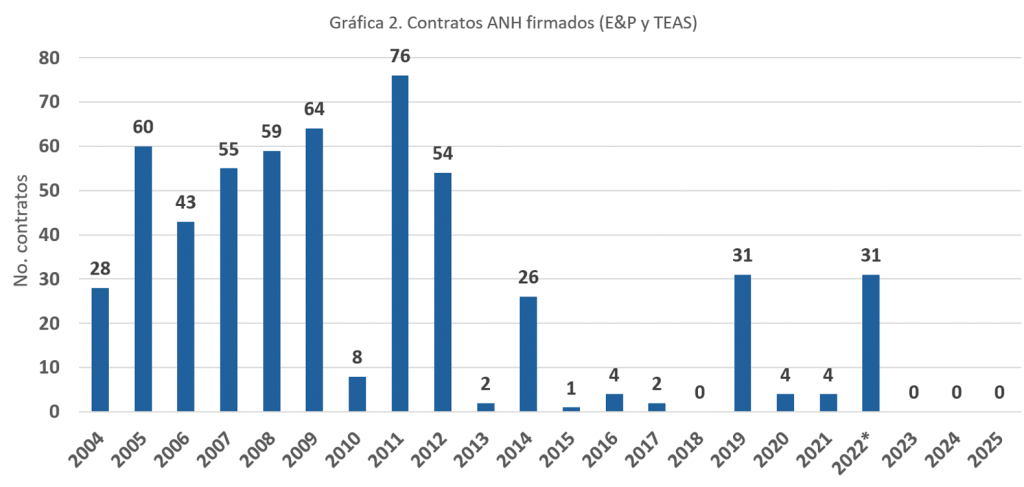
From that moment on, the Agency began an exhaustive promotion of the country to investors worldwide and structured the regulations in a way that promoted its competitiveness, making Colombia an attractive destination for investment. Unmistakable signals of support for the private sector and stable and predictable rules allowed for the successful execution of area allocation processes that culminated in the signing of exploration and production contracts for hydrocarbons. As a result of this policy, the year 2011 marked a milestone in this process, with the highest number of exploration and production (E&P) and technical evaluation (TEAS) contracts signed, 76 in a single year.
Unmistakable signals of support for the private sector and stable and predictable rules allowed for the successful execution of area allocation processes that culminated in the signing of exploration and production contracts for hydrocarbons.
In this way, Colombia attracted world-class investors who brought specialized knowledge and cutting-edge technology, factors that allowed the extractive industry to take off, boost regional development, and generate significant economic contributions that have helped sustain the Nation's public finances. International companies such as Shell, ExxonMobil, Oxy, Repsol, Anadarko, Petrobras, Drummond, Parex Resources, GeoPark, Gran Tierra Energy, and Tecpetrol, among others, are examples of the companies that have ventured into Colombia and have built from and with the territories.
Currently, the situation is different, as although international conditions have been favorable for the industry, in Colombia, in recent years, the sector has been affected by additional tax burdens (surtax on income tax and export tax), changes in environmental licensing and land use regulations, endless prior consultations, rising social conflict, absence of public order, among other factors.
Furthermore, it has been mistakenly decided not to sign new exploration and production contracts and to stop the pilots for the development of unconventional reservoirs through fracking technique. These factors have resulted in lower investments in exploration and production, which means that Colombia today presents the lowest levels in the reserve recovery index for both gas and oil.
According to analyses conducted within the ACP, if the course is not corrected, it will be impossible to meet the Medium-Term Fiscal Framework that contemplates oil production close to 750 thousand barrels per day, and the country will be forced to import gas to cover the essential demand of households, businesses, industries, and vehicles.
The decline in oil production will generate lower revenues amounting to approximately 40 trillion pesos by 2035, which will mean fewer resources to invest in education, health, and infrastructure. The increase in gas imports will lead to higher bills for Colombians within the country by amounts close to 20% or up to 45%, with significant inflationary impacts and impoverishment of the most disadvantaged.
In this scenario, it is essential to reverse the policy of industry withering, avoid at all costs the decline in production, increase exploratory activity as the main mechanism to incorporate reserves, and attract foreign investment with major players. Only in this way will it also be possible to increase royalties and revenues that guarantee the stability and economic future of the country and its regions.
It is essential to reverse the policy of industry withering, avoid at all costs the decline in production, increase exploratory activity as the main mechanism to incorporate reserves, and attract foreign investment with major players.
From the ACP, we have proposed some initiatives that contribute to the growth of the oil and gas industry, among which the following stand out:
- Reactivate the allocation of areas and sign new contracts.
- Advance with the development of projects in unconventional reservoirs.
- Promote the development of offshore projects.
- Optimize prior consultations and stabilize environmental requirements.
- Exercise state coordination to manage conflict and ensure public order.
- Provide signals of political, legal, and regulatory stability.
The hydrocarbon sector has been, and continues to be, an economic pillar of Colombia. Its contributions to GDP, public finances, the trade balance, and regional development are undeniable; changing the course and promoting the growth of hydrocarbon exploration and production will generate benefits in the short, medium, and long term for the country, the regions, and all Colombians, while ensuring our energy security, under the principles of addition and complementarity.
By: Andrés Bitar
Vice President of Strategy and Regulatory Affairs of ACP
 Colombian Association of Oil and Gas