
Expanded view of the energy matrix within the framework of the transition: The role of hydrocarbons in Colombia to ensure energy security and affordability

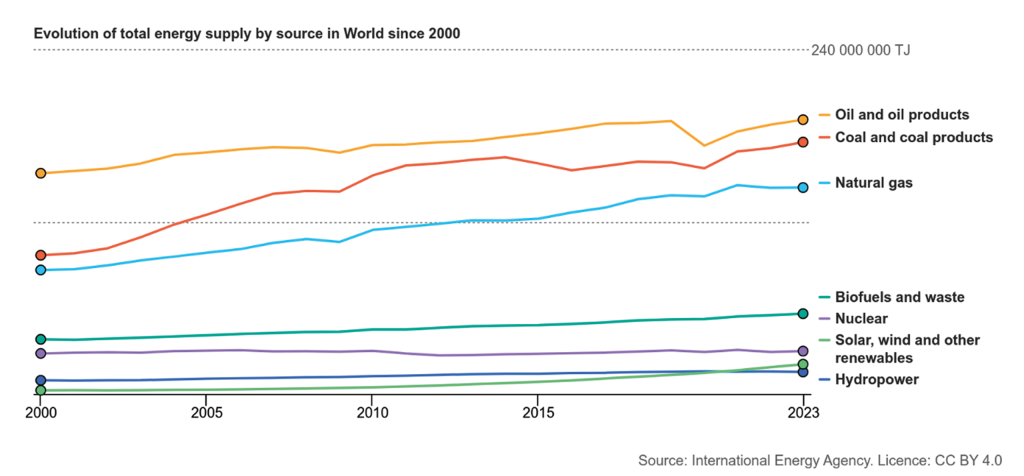
At a global level, the primary matrix continues to be dominated by hydrocarbons. According to the International Energy Agency (IEA), in 2023 oil and its derivatives accounted for 30.21% of the supply, coal 27.81%, and natural gas 22.71%. In Colombia, the dependence is greater: oil, its derivatives, and gas exceed 60% of the supply, and water has a distinctive relevance in electricity generation.
This context, along with the projected growth in demand, the reduction of reserves, and the increasing dependence on imports of gas and derived fuels, poses a central challenge: how to ensure supply and reasonable prices while meeting the commitments of the Paris Agreement?.
To address this question, I review global and national trends, contrast demand with reserves and production, and analyze the need to reactivate hydraulic fracturing in unconventional fields and to resume exploration and production (E&P) contracts. The above aims to balance the three pillars of the energy trilemma of the World Energy Council: energy security, affordability, and sustainability.
Evolution of the energy matrix, multilateral commitments, and transition trends
The IEA graph presents the evolution of the energy matrix. As of 2023, the supply of primary energy came from oil and derived fuels at 30.21%, followed by coal at 27.81% and natural gas at 22.71%. The consumption of these three energy sources has shown a growing and constant trend since the year 2000.
In 2015, two milestones were consolidated at the multilateral level regarding climate change and the evolution of the energy matrix: 1) the Paris Agreement, which urges keeping the temperature increase below 2 °C, ideally 1.5 °C, through commitments to reduce emissions (nationally determined contributions, NDCs); and 2) the 2030 Agenda, whose Goal 7 seeks to ensure affordable, reliable, and sustainable energy.
This vision converges with the energy trilemma: ensuring supply security (self-sufficiency and less dependence on imports), ensuring affordability (coverage and reasonable prices), and advancing sustainability (decarbonization).
The Net Zero by 2050 roadmap of the IEA proposes five pillars:
- Investment in energy efficiency and behavior change to reduce consumption.
- Electrification with renewables (hydraulic, solar, wind, biomass, geothermal) supported by storage.
- Expansion of low-carbon hydrogen in industry and its blending in gas networks.
- Greater use of modern bioenergy (biomass for electricity, biofuels, biogas/biomethane).
- Carbon capture, utilization, and storage (CCUS).
The IEA also emphasizes that the oil and gas sector can reduce emissions by electrifying operations with renewables and incorporating CCUS.
Daniel Yergin warns that the problem of climate change is global, but each country's response must correspond to its particular situation. In the energy transition process, “developing countries will face difficulties in finding a balance between low carbon emissions and the need for low-cost energy solutions to promote economic growth.” The Paris Agreement itself, in its Article 4, recognizes differentiated efforts from developing countries that, over time, should expand their mitigation targets according to their circumstances.
The energy transition in Colombia amid the loss of self-sufficiency of the main energy sources.
Colombia's primary matrix differs from the global one. Oil and its derivatives represent 41.31% (compared to 30.21% globally) and natural gas 21.41%. Water contributes 10.11% (well above the global 2.41%).
Energy demand by 2050 —according to the Mining-Energy Planning Unit (UPME)— will grow, driven mainly by transportation (almost half of consumption) and industry. This pressure contrasts with the reality of reserves and production of the energy sources that sustain more than 60% of the energy supply in Colombia.
The National Hydrocarbons Agency (ANH) confirms a decline in natural gas reserves in the country, evidencing by 2024 proven reserves (1P) of 2.064 Gpc, below the 5.9 years of self-sufficiency.
According to UPME projections, the natural gas shortage would begin in 2027, even with gas imports through the SPEC regasification plant.
In terms of oil and derived fuels, ANH highlights that proven reserves (1P) have remained stable with an R/P factor of 7.2 years of self-sufficiency.
UPME projects that regular gasoline will face the greatest relative deficit, followed by diesel and jet fuel, even considering local refining capacity (the green bar in the graphs Source: UPME corresponds to projected imports to meet demand).
Daniel Yergin notes that, so far, the energy transition is in a phase of aggregation of energy sources, in the sense that renewable technologies have continued to grow “but they were doing so based on conventional energy, which was also growing.”.
Energy demand by 2050 —according to the Mining-Energy Planning Unit (UPME)— will grow, driven mainly by transportation (almost half of consumption) and industry. This pressure contrasts with the reality of reserves and production of the energy sources that sustain more than 60% of the energy supply in Colombia.
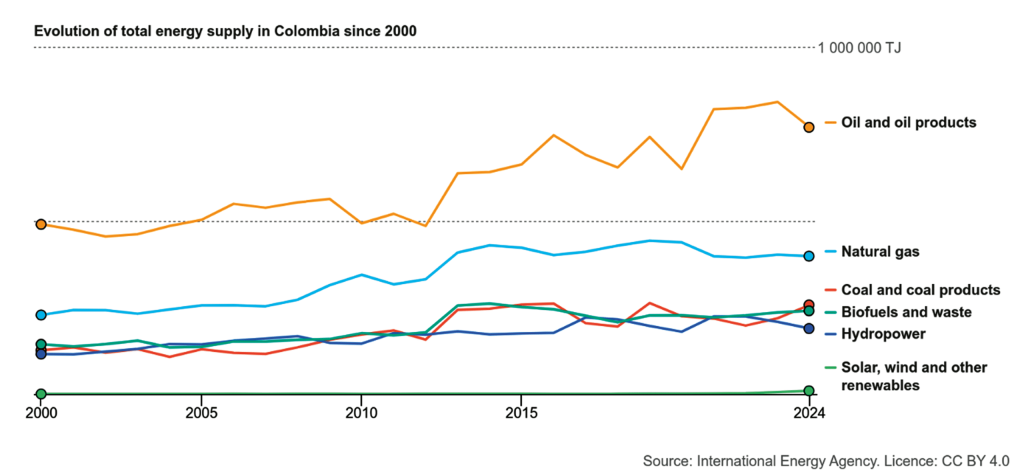
In the Colombian case, the base of the matrix consists of natural gas, oil, and its derived fuels. The supply of the latter is in decline, raising concerns about rising energy prices (affordability) and energy sufficiency in the most concerning scenario.
See more graphs in pdf version
One of the most decisive political decisions to restore affordability and energy sufficiency in the medium term is the increase of reserves and production from unconventional deposits through hydraulic fracturing technique.
One of the most decisive political decisions to restore affordability and energy sufficiency in the medium term is the increase of reserves and production from unconventional deposits through hydraulic fracturing technique.
The Comprehensive Research Pilot Projects (PPII) in the Middle Magdalena Valley estimated a potential more than three times the 1P crude oil reserves and 12 times the gas reserves in that basin; and, considering five prospective basins, more than four times the 1P oil reserves and 53 times the gas reserves of the country. A development period of 7 to 10 years is projected, consistent with the maturation times of the industry. In simple terms, this alternative represents recovering energy sufficiency and affordability.
Decrees 3004 of 2013 and 328 of 2020, which enable exploration and production from unconventional deposits through hydraulic fracturing, remain in effect. Additionally, Legislative Project 150 of 2024, which aimed to prohibit “the use of hydraulic fracturing technique,” did not become law. Consequently, resuming this alternative depends on a political decision that recognizes the benefits of integrating state-of-the-art “advanced technologies to optimize the extraction of unconventional hydrocarbons and reduce environmental impacts,” as mentioned by Juan Benavides in his ‘ABC of fracking,’ ensuring affordability and energy security.
Additionally, ANH, which until 2021 conducted periodic rounds of block allocation under the Permanent Area Allocation Process modality, has suspended all new contract subscriptions. In the last award, called Round Colombia 2021, ANH signed 30 contracts for 30 exploration and production areas. The de facto moratorium on the awarding of new E&P contracts is another decision that disrupts energy security and affordability, and it only requires political will to recover the path of self-sufficiency.
As the energy transition progresses, hydrocarbons continue to be the backbone of global supply and, with greater intensity, of the Colombian supply. In the country, demand will have an increasing trend, but proven reserves of natural gas and oil present a risk scenario of supply shortages. Furthermore, the UPME projects dependence on fuel imports —critical in gasoline— and natural gas. This reality presents an imbalance regarding two pillars of the energy trilemma: energy security and affordability.
Consequently, public policy must avoid an unbalanced transition and, for this purpose, it is key to:
- Recover the path to self-sufficiency through the development of unconventional deposits via hydraulic fracturing, applying state-of-the-art technology and environmental and social standards; and
- Resume competitive processes for the allocation of exploration and production contracts.
In parallel, decarbonization remains a global objective and must be accompanied by energy efficiency, electrification with renewable energies, low-carbon hydrogen, bioenergy, and CCUS. Only in this way can we move towards a balanced, realistic, and sustainable energy transition for Colombia.
By: José Plata Puyana
Regulation teacher
and energy transition
 Colombian Association of Oil and Gas