
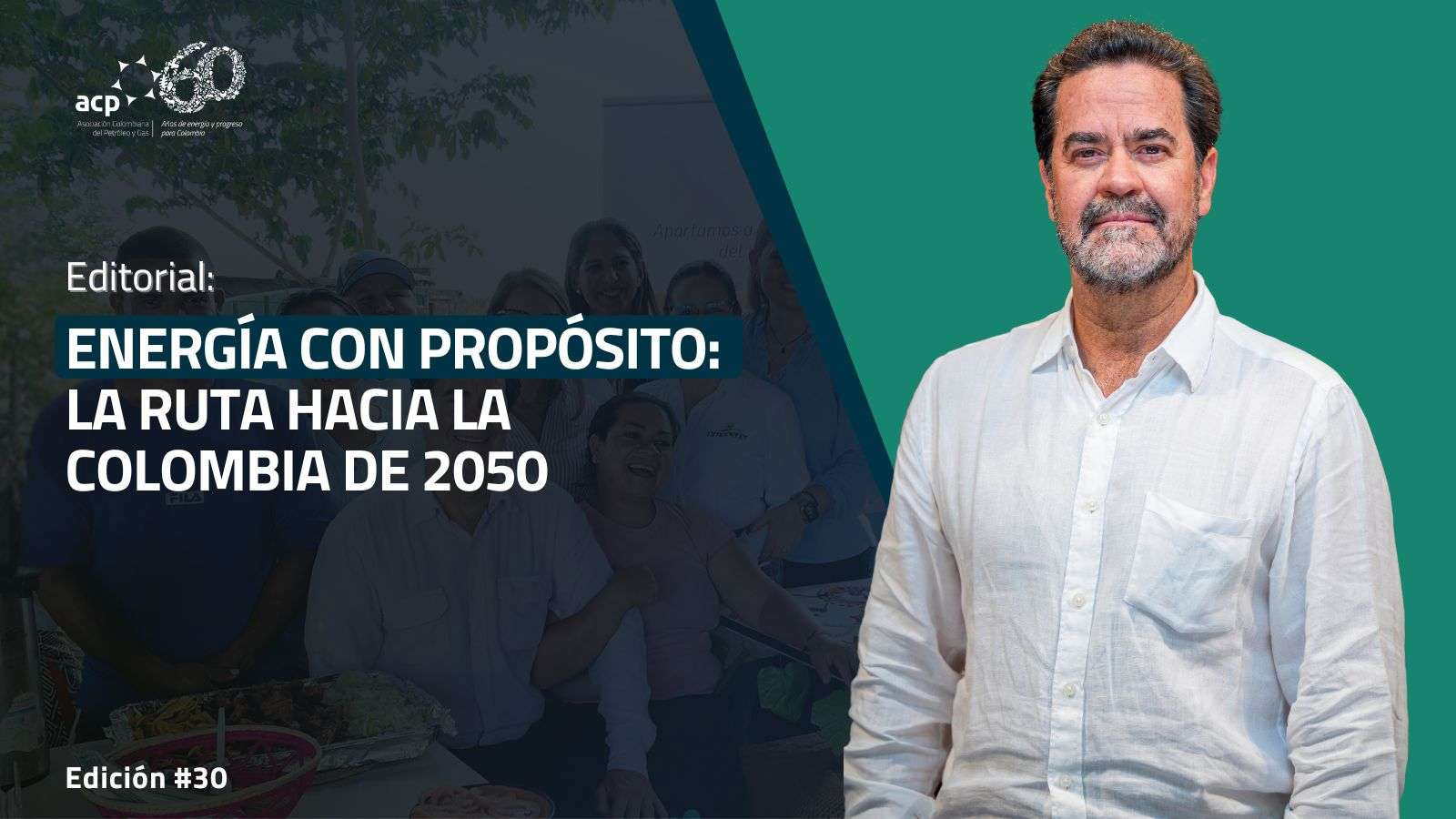
The world's energy map is changing faster than ever. The transition to complementary and low-carbon energy sources, the technological revolution, the growing demand for critical minerals, and demographic movements are transforming geopolitics, economic and diplomatic relations, and markets.
Today it is even clearer that energy is no longer a purely technical and economic matter: it is a pillar of the sovereignty of countries, the axis of security, sustainability, and social stability.
Colombia is not immune to these changes and finds itself at an apparent crossroads that will define its development in the coming decades: how to maintain energy security and competitiveness while moving towards an energy matrix with sources that complement oil and gas, that is efficient and fair. More than a technical challenge, it is a political and social challenge. It requires planning, a state vision, and, above all, trust among the actors that sustain and benefit from the energy system.
On this 60th anniversary, the Colombian Association of Oil and Gas reaffirms the conviction that has guided its work since its creation: energy is progress and progress is only possible when there is security, dialogue, and common purpose.
For six decades, the history of the ACP and the hydrocarbon sector has been linked to the development of the country. Each well drilled and each investment in exploration has meant more than figures; they have represented the presence of the State in forgotten territories, formal employment, infrastructure, and well-being.
The sector has demonstrated its capacity to adapt to price cycles, regulatory changes, the pandemic, and social challenges. In every crisis, it has responded with investment, innovation, and responsibility. That resilience—forged in the experience and commitment of companies and their workers—is one of Colombia's most valuable assets to face the future.
The history of the sector is also written in works that transform lives: roads that connect previously isolated municipalities, schools built with royalty resources and equipped through Tax Works projects, as well as aqueducts that bring drinking water to rural communities. The coordinated work between communities, authorities, and companies has generated concrete results that have changed the face of producing regions. That vocation for service and territorial development will be key in the coming years.
Today the country faces a different scenario. The challenges are different: maintaining production, ensuring supply, reducing emissions, and moving towards an orderly energy transition. In that process, the accumulated experience of six decades is a platform to build the future.
The next decade will be decisive. According to the International Energy Agency, by 2030 renewable energies could provide more than 40% of global electricity, while total energy demand will continue to grow, driven by urbanization, digitalization, and electric mobility. Even so, hydrocarbons will remain essential, especially in industry, heavy transport, and heat generation.
Major economies are already betting on a diversified portfolio that combines sustainability, competitiveness, and security. The United States is allocating billions of dollars to boost the industry with lower emissions; Europe is accelerating green hydrogen; and China is leading in storage and critical minerals. In this context, Latin America has a unique opportunity: to be a reliable provider of responsible energy for a world that demands sustainability without giving up stability.
Colombia can play a relevant role in this new scenario if it understands that the transition is not a leap into the void, but a gradual process that leverages its strengths —gas, oil, vocation, and institutions— to finance and accelerate change.
The country's energy future must be built on three pillars. The first, security, because without territorial control, clear rules, and respect for institutions, no energy policy is viable. The sector has been the target of illegal and illegitimate attacks and blockades that affect regional finances, communities, companies, and ecosystems. Ensuring security also means protecting the energy that makes the country function.
The second, competitiveness. Colombia needs to attract investment in exploration and production, in oil and natural gas, in infrastructure, and with lower carbon emission technologies. The transition will be possible if a stable and predictable environment is guaranteed. An energy policy of the state, which transcends several governments, based on technical evidence and a political and social consensus, must be the starting point. Without that long-term vision, the country risks failing to regain its self-sufficiency and depending on more expensive imports than local alternatives.
And the third, trust. The transition is not imposed: it is built between the State, communities, civil society, and the private sector. Colombia needs a more technical and less ideological dialogue that reconciles the urgency of recovering our energy security with the environmental and social challenges of the regions. Producing hydrocarbons makes more sense when its impact is measured not only in macroeconomic figures but also in advances in productive diversification and social equity.
In this process, natural gas is the fuel of the transition. With fewer emissions than other fuels, it is available locally and can guarantee supply for electricity generation, industry, and households.
Betting on more exploration and production of oil and gas is facilitating the energy, economic, and social transition that Colombia requires.
2050 is not that far away. Very soon, Colombia will have to define how to balance its need to modernize its economy with social challenges and environmental opportunities. Governments will change and technologies will evolve, but the essential will remain the same: energy as the basis of progress and national cohesion.
Upon turning 60 years old, the ACP renews its commitment to being a space for technical and constructive dialogue, to promote policies that integrate sustainability, competitiveness, and well-being, to find solutions.
The hydrocarbons sector is a great ally in building a more prosperous and sustainable future.
Colombia has what it takes: talent, experience, and a service vocation. It has companies that believe in the country and communities that expect results. What we need now is trust and a shared vision. The energy future is not decreed: it is built, step by step, with evidence, cooperation, and purpose.
Because with energy there is progress. And with progress, there is a good future for all.
 Colombian Association of Oil and Gas