
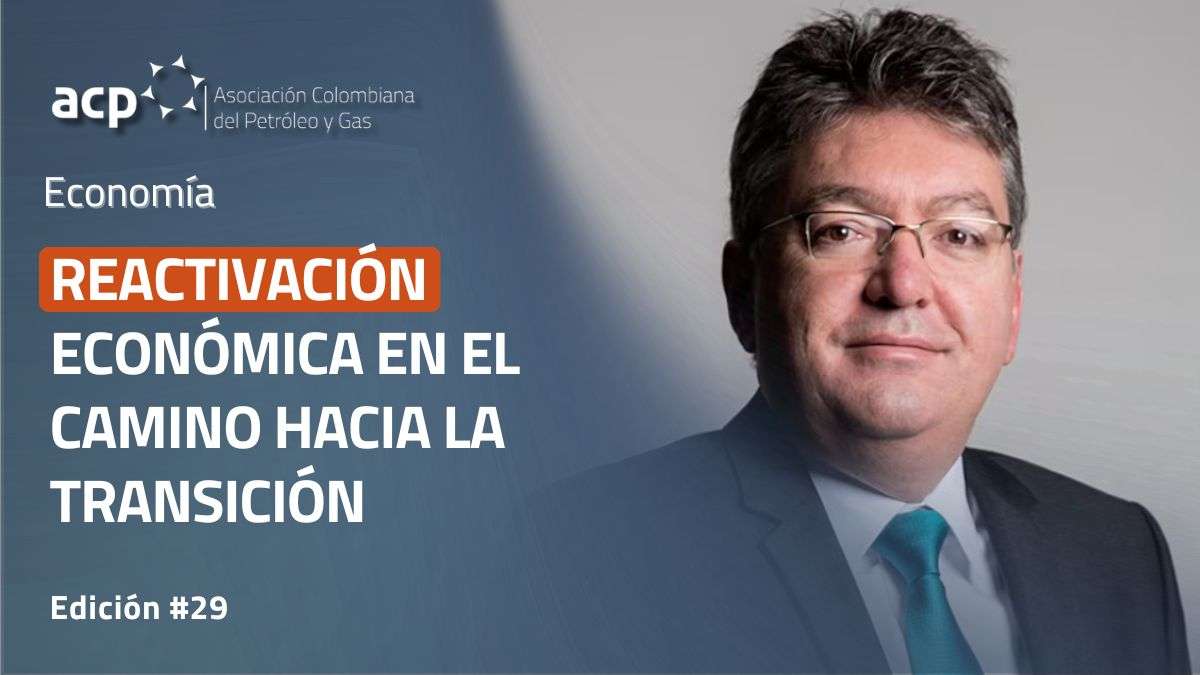
The former Minister of Finance talks about the impact that the energy transition will have on the country's economy. He makes recommendations to consider in the formulation and implementation of the process.
In this interview, economist Mauricio Cárdenas talks about the relationship between the energy transition process and the finances of the Colombian state. He says that the national government has overlooked that the transition is a long process, as it must include alternatives for reindustrialization in the country to avoid a harsh blow to the national economy.
How should the country balance the need to reactivate and strengthen the economy with the interest of advancing, even accelerating, the energy transition?
Mauricio Cárdenas: The two objectives are compatible. The country must advance in a process of decarbonization of the economy and, at the same time, accelerate its economic development. In particular, its economic growth. That is, they are not two exclusive processes; they must be harmonized.
The question then is if that is the objective, what is the best strategy to achieve it? That is where I have serious disagreements with the strategy used by the current government. In both cases, there is some level of convergence regarding the objectives, but there are divergences in the way to achieve them.
What would be your recommendation, or your suggestion, to achieve it?
M.C.: My suggestion is, on one hand, to prepare for the moment when the world stops using fossil fuels, which is likely further away in time than we can see today. On the other hand, to fight internationally so that the path towards that is the least burdensome for a country like Colombia.
The logical consequence of not being the causes of climate change is that we should not be the ones who bear the highest costs in the solution. On the contrary, we should be the ones who bear the lowest costs.
The strategy of the current government goes in the direction of assuming the highest costs. That, in my opinion, is incorrect because it is not what a country like Colombia needs. It is also not equitable, because we should rather be on the side of those who have to incur more sacrifices to achieve that decarbonization process.
I have a difference in approach with President Petro's government, which considers that Colombia should be the one to take the first step. We must take steps, but not necessarily assume the costs.
How should we advance in that preparation for decarbonization?
M.C.: The first thing is to understand that our position in the world, as emitters of greenhouse gases, is not that of a country that generates many emissions based on energy consumption.
Our problem is not energy consumption; our problem is essentially deforestation. That is the big problem that Colombia has, which instead of contributing solutions, is worsening the situation, because we could perfectly be part of the solution.
The first thing we have to do is stop deforestation; to achieve this, moralistic positions are not needed. We need to analyze what the cause of deforestation is. And that cause is economic, as it is profitable to deforest because there is no better alternative. So we need to bring economic incentives to the territory to stop deforestation, and that costs money. Part of it can come from the international community, to whom we can sell carbon credits. But we will also have to contribute some with our own resources.
Therefore, the conversation should not be dominated by whether we are going to produce oil or not. It should be about how we are going to stop deforestation, what economic incentives we are going to provide to achieve it. That is my main difference in approach with President Petro. If the problem to prevent deforestation is one of resources, we must make the most of every last cent that fossil fuels give us to stop it.
We would be doing a great service to humanity, to climate action, if we continue producing oil and use the resources it provides to stop deforestation.
Returning to the purpose of strengthening the economy and making it more diversified and sustainable, what do you consider to be the main challenges and opportunities that the country has?
M.C.: Colombia has undergone a process of deindustrialization; that is the main problem. It has not really managed to develop its agricultural potential. Although the service sector has made progress, we could still do much more, including services like tourism.
The diversification of the economy involves taking advantage of agricultural potential to reindustrialize the country and further develop the service sectors. All of this, from any angle, requires state support, public resources, tax incentives, infrastructure, or education; in short, all of this requires fiscal contributions.
So, if oil is our main source of fiscal income, we should not disregard those resources. Rather, we should be thinking about how to transform them into activities that give us the potential for reindustrialization. On one hand, from agricultural development and, on the other hand, from the service sector.
If we invest oil resources in the State payroll, we will not achieve those objectives. In that model, the payroll ends the day the oil resources run out and the country did not win, did not grow. Simply put, it paid more payroll during the time it had oil. Therefore, during the time we produce oil, we must invest in human capital, physical capital, and in stimulating private investors to take business decisions, investment initiatives. That is well-invested money and what we need to do is transform oil revenue into that.
How do you see the role of private investment, foreign investment, in the context of energy transition and economic reactivation in Colombia?
M.C.: It is very important. But foreign investment always wants to have stability, looks at the macroeconomic fiscal situation, and wants to see that countries are not making a leap into the void and that tomorrow they will not run out of fiscal resources or external resources. That is what would happen to Colombia if we run out of oil.
For the simple objective of maintaining foreign investment, we must maintain a model where the revenues we have today are solid, that they will be there to respond to that investment tomorrow.
How to incentivize those investments that the country so desperately needs to guarantee energy security, fiscal stability, and socio-economic and diversified development in the regions, mainly in the hydrocarbon-producing regions?
M.C.: We need a lot of stability in the rules of the game, not to be changing them permanently. That is the first point.
In addition, we need to provide incentives for certain sectors that interest us in particular. And, at the same time, contribute resources for infrastructure development. For example, roads, university education, public utility services. The State needs to contribute either public resources or regulation, but without the State, it is very difficult to develop that type of infrastructure. So it should rather be focused on making alliances with the private sector to develop all that infrastructure.
What are the consequences of a policy that does not promote that type of investment and sectors like this?
M.C.: There is a timing problem because the costs of today’s discourse will materialize tomorrow.
What are today applause, political support for the Government's positions, will turn into pain in a few years. What makes managing a situation like the current one very difficult is that those pains are not being felt yet, and when they are felt, it will be too late to correct.
One must be very persuasive and explain why those applause today have significant costs later on. That cost is going to be very material. All those who benefit from some state support critically depend on the resources that the oil sector currently provides us. So, tomorrow that is what will be at stake.
The problem is that the two phenomena do not occur simultaneously, which gives a certain advantage to those who manage the political discourse against the sector. That is why this discourse has, so far, had electoral majorities.
There is talk of the importance of not depending on a single economic sector to advance towards diversification as a pillar of economic development. How is that diversification achieved? Does the hydrocarbons sector contribute to that process?
M.C.: The debate is not whether we should diversify or not. We all agree that we need to diversify. There is also no debate about whether climate change is a problem, nor about reducing the use of fossil fuels in the future. We know that it is. The question is how we are going to achieve diversification.
Here, shock therapy, that is, stopping abruptly, is not the best strategy. If we do this with this industry, when we do not yet have alternatives developed, it will be negative. There is a very caricatured talk, for example, that avocado will be the alternative, but the difference between avocado and oil could mean stopping receiving 60 to gain 1.
So, the question is how do we make that 1 become 4 or 5 and other products appear and contribute as well, so that we can replace oil with that. But it is a process that takes time; eliminating it outright or doing shock treatment will not solve the problem. We will not have enough time or resources to build those alternatives.
These are built with infrastructure, human capital, tax incentives, and a macroeconomic stability that allows attracting foreign investment. That goes hand in hand with having fiscal resources.
Finally, you have analyzed the costs of the energy transition in Colombia, how to finance it? Should the country use the resources coming from the hydrocarbons sector for the transition?
M.C.: The transition in Colombia is costly. Because we have to consider that the most important part of our emissions is associated with deforestation, and that we have a dependence on fossil fuels. Moreover, many countries are adopting protectionist measures. For example, in Europe, we can no longer sell under the same conditions as we did before.
In the great global geopolitics, we have more to lose than to gain. We have markets that are closing, high costs like what it means to reduce hydrocarbon production, and resource needs to stop deforestation. Comparatively with other countries, where the problem of reducing emissions is solved by switching to renewable energy sources, for us it is more costly.
We are in a position where we must defend, above all, the interests of Colombia. Stopping oil production before the rich, like Norway, Saudi Arabia, and the United Arab Emirates, is contradictory to the need to protect our interests first. The interests of Colombians.
 Colombian Association of Oil and Gas