
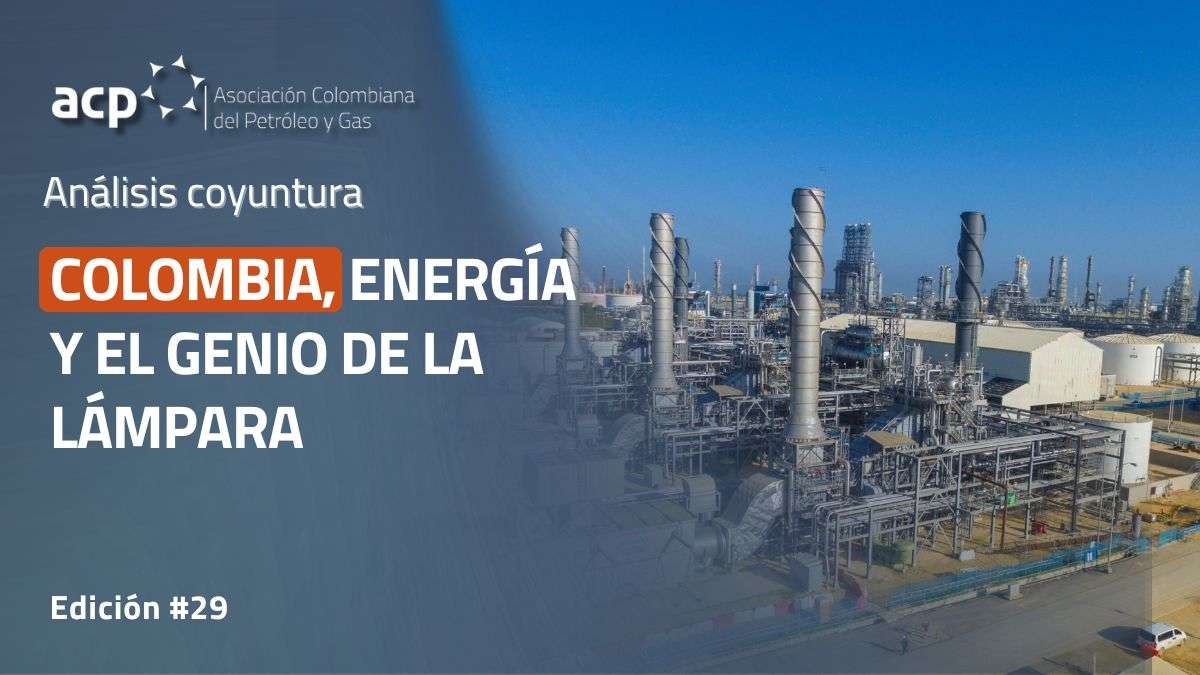
The country has the advantages of having a clean energy matrix and reserves of gas and oil in its territory. However, it now faces the challenge of effectively managing those blessings.
By: Nicolás Azcuénaga Ramírez
The “genie of the lamp” appeared to Colombians and granted us three wishes: to have a clean electric matrix, oil, and gas in our territory. Just like in the tale of One Thousand and One Nights, more important than the granted wishes is what the fortunate recipient does with them. Like Aladdin, Colombians must decide what to do with the happy concessions, which in the end will determine whether they result in good fortune or a curse.
The first granted wish was for a clean electric matrix, currently driven by hydroelectric generation, which represents about 67% of the installed capacity. This contributes, along with the size of the economy and other factors, to Colombia having per capita CO2 emissions of 1.7 tons per year, well below the global average of 4.8 tons. Additionally, the generous genie, thinking of the future, gave us an exceptional wind energy resource located in La Guajira, which can reach 15,000 MW. This is equivalent to about 70% of the currently installed capacity.
Colombia has per capita CO₂ emissions of 1.7 tons per year, well below the global average of 4.8 tons.
The second wish was to have oil. While we are not, and will never be, an oil-producing country that is a member of OPEC, we are fortunate to be self-sufficient. The bulk of the liquid fuels we consume is produced from domestic crude oil in Ecopetrol's refineries, which even leave material surpluses for export. For example, in June 2024, 13.3 million barrels of crude oil were exported; that is equivalent to 443 thousand barrels per day, contributing more than 30% of Colombia's exports. In terms of crude oil reserves, at the end of 2023, the indicator against production shows that we have oil for 7.1 years.
In June 2024, 13.3 million barrels of crude oil were exported; that is equivalent to 443 thousand barrels per day, contributing more than 30% of Colombia's exports.
The good genie also granted us a third wish, to have gas. This, according to the Natural Gas Roadmap in Colombia developed by the Regional Center for Energy Studies (CREE), is a fundamental fuel for an energy transition in all decarbonization scenarios. Natural gas, while still a hydrocarbon that generates CO2 emissions, has the particularity of producing 45% less emissions than coal, 25% less than gasoline, and 16% less than propane. Additionally, it has the capacity to increase coverage by displacing firewood, which is still used by about 1.8 million families in the country, with the consequent health problems generated by smoke, affecting the lungs and eyes of those who use it for cooking, mostly women. Gas also allows for meeting national energy demand with the required firmness, absent in renewable sources like solar and wind due to their intermittency. All these advantages at an efficient cost.
Thus, Colombia has a potential volume of contingent resources (3C) of 7,506 billion cubic feet of gas, in addition to the already existing 2,373 of proven reserves that we have at the end of 2023, which represent 6.1 years of reserves at last year's production rate. That is, this figure does not yet account for the entire increase in gas demand generated by the rise in gasoline prices.
The genie set us a single requirement: we must agree and coordinate to extract this gift from the Caribbean Sea. It was the test he set for us to challenge our ability to overcome differences, disputes, and selfishness. The genie wants to verify Colombians' ability to unite for a common interest, beyond the Colombian National Football Team.
In terms of natural gas, we are used to being a sovereign, self-sufficient country with affordable prices. That happiness will soon end, and the supply and demand outlook indicates that, starting in 2025, and progressively until offshore gas enters the system, our luck will turn, and we will become a country dependent on imports, with potential supply restrictions and consequently higher prices. Here, the dark humor of the clever genius is evident; it is necessary for Ecopetrol, Shell, Petrobras, Sierracol, Hocol, TGI, Promigas, the communities, the ACP, Naturgas, CAMPETROL, the ANLA, the Ministry of Environment, DIMAR, the Ministry of the Interior, CREG, the Superintendency of Public Services, the Ministry of Defense, the Ministry of Mines and Energy, UPME, and ANH to work in an articulated and coordinated manner to reduce the deficit of our own gas that we will inevitably experience.
Colombia has a potential volume of contingent resources (3C) of 7,506 billion cubic feet of gas, in addition to the already existing 2,373 of proven reserves.
It is demonstrated that Colombia is a fortunate country in terms of energy resources, both renewable and non-renewable, conventional and unconventional. We are far from being one of the richest countries in this area, but we certainly have more than enough to meet our demand and even have a surplus for export. Furthermore, the mix of energy resources and its geographical location lend themselves to making very interesting bets, combining the firmness of gas with the cleanliness of wind and solar resources; the Colombian Caribbean has the incredible potential to become a world-class energy hub. The genius has treated us well; the question now is whether we will know how to take advantage of it.
Like Aladdin, Colombians must decide how to act in response to the favors received. For example, deciding whether we will sacrifice oil exploration and production in order to immediately reduce emissions, even though this may deteriorate national finances. Whether we will seek and develop gas resources and when we will do so; whether we will use the renewed volumes of gas to increase coverage of this service in the territory, thus promoting energy inclusion; whether we will seek to replace the demand for coal and liquid fuels in favor of gas, in order to reduce the country's emissions. Or whether we will seek to enable investments in wind farms in La Guajira, which have not been successful so far, to access the energy cleanliness of this resource. In summary, we have admirable energy wealth; it is in our hands, or rather, in our actions, that the favors received turn into value, quality of life, and prosperity for current and future generations.
 Colombian Association of Oil and Gas