
The integral role of hydrocarbons in the energy transition
Although the role of hydrocarbons in the energy transition is central for it to be fair with the energy demand in the world, the need to continue investing in the exploration and production of these commodities is often ignored.
The world has experienced significant changes in recent decades that have shaped the societies in which we live. Among them, there are three socio-economic changes of particular importance: accelerated economic growth, rapid population increase, and the rise in the rate of urbanization globally. These have gone hand in hand with a rapid growth in energy demand. In 1974, the world consumed 254 EJ (Exajoules) of energy, while in 2024 the demand has multiplied by 2.5 times, reaching 646 EJ.
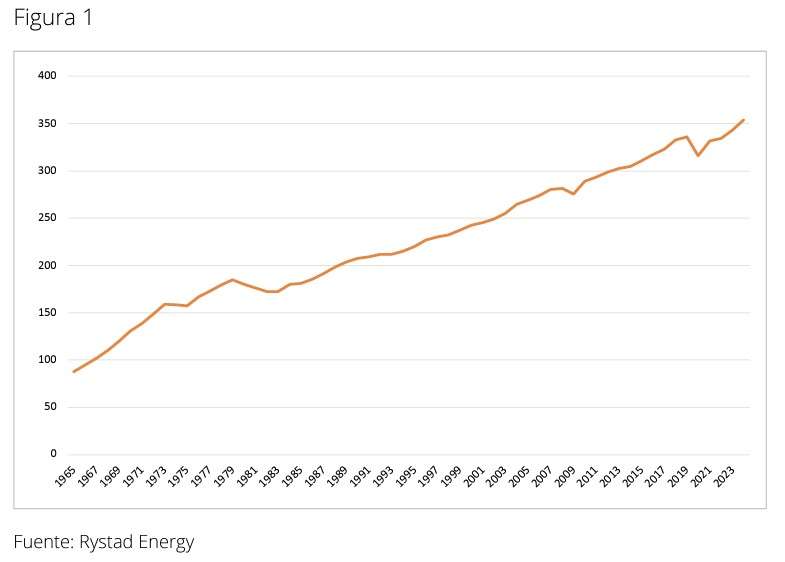
Hydrocarbons have been key to meeting that rapid increase in energy demand, which has led to the realization of the current global economic development. The demand for oil and natural gas has grown almost constantly in recent decades at a rate of 2% each year.
Global demand for hydrocarbons
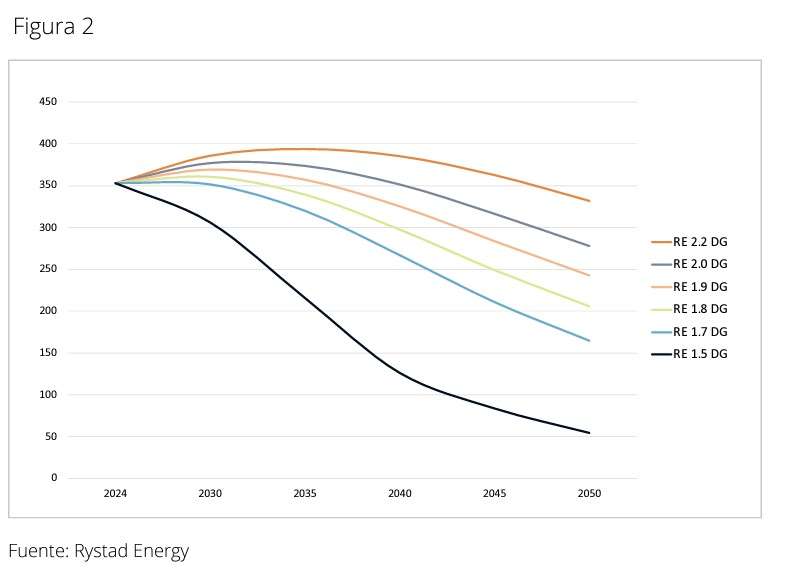
Scenarios for global demand for hydrocarbons
But the world we live in right now is likely very different from the one that awaits us in the coming decades. The energy transition, rapid technological development, the implementation of public policies focused on a sustainable ecological future, and greater collective awareness of the need to address climate change understandably raise questions about the role that hydrocarbons will have in a greener future.
While it is true that there is broad consensus that, in the future, the demand for hydrocarbons will not grow as fast as in the past and will likely begin to decline, the degree of uncertainty about when and at what rate it will start to decrease is extremely large. Based on Rystad Energy scenarios, the demand for hydrocarbons could drop from 350 EJ in 2024 to 126 EJ by 2040 (Figure 2) in a scenario with an average global temperature increase of 1.5 degrees. Alternatively, it could rise to nearly 400 EJ by the middle of the next decade and slightly fall to 385 EJ by 2040. In this scenario, the average global temperature increase will be 2.2 degrees. This wide range in predictions about future hydrocarbon demand is due to the uncertainty generated by the evolution of public policies, social preferences, and the development of new technologies.
Despite the uncertainty in predictions, there are two important elements that are certain, regardless of the scenario. The first is that the demand for hydrocarbons will not disappear, at least in the next two decades. The second element is that, in any scenario, there is an urgent need to continue investing in the exploration and production of hydrocarbons. These two elements clearly show that hydrocarbons will continue to play an important role in the coming years amid an energy transition, regardless of whether it is accelerated or slow.
The demand for hydrocarbons in the future will remain because decarbonizing certain sectors (for example, those that require high temperatures, such as industrial production of steel, cement, and iron, along with the petrochemical industry, the aviation industry, and heavy transport) is extremely complicated and costly. Similarly, the rapid growth of electricity demand makes the use of natural gas in that sector necessary, despite the expected increase in the penetration of renewable energies.
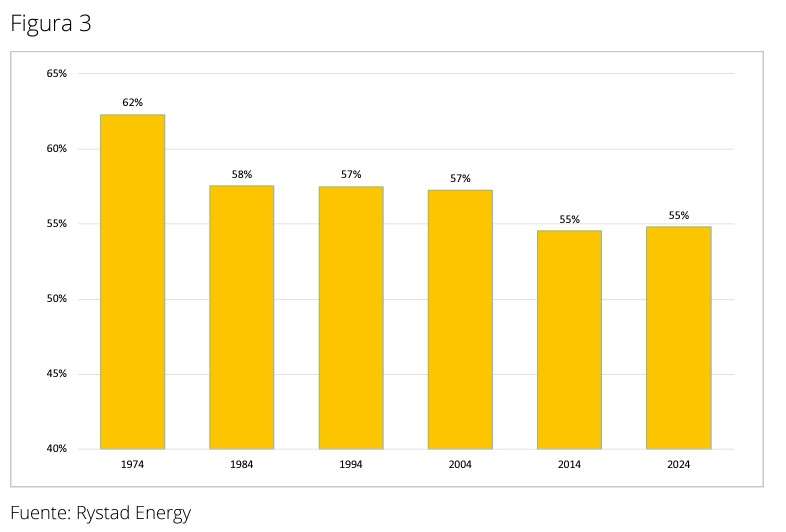
In this regard, it is interesting to note that, despite the implementation of green public policies, the increase in the penetration of electric cars, and the rapid growth of renewable energies in recent years, the share that hydrocarbons represent of the total energy demand globally in 2024 is practically the same as it was 10 years ago and only very slightly lower than the share 20 or 30 years ago. This clearly shows that the demand for hydrocarbons is “sticky.” Therefore, expecting to see a very rapid decline in the coming years is an unlikely scenario.
Share of hydrocarbons in the global energy mix
The need to continue investing in the exploration and production of hydrocarbons, regardless of the scenario that each one considers most realistic, is often ignored. In recent years, international development banks, various governments, international organizations, and part of the financial sector have advocated and defended the thesis in favor of the need to stop investment in exploration and production as a necessary measure to limit the demand for hydrocarbons and reduce carbon dioxide emissions.
There are two major flaws in this line of reasoning. First, to limit the demand for hydrocarbons, public policies that impact demand must be implemented, not supply. Limiting future supply by restricting investment in exploration and production would create distortions in the market in the future, with rapid price increases that could have negative global macroeconomic consequences. Second, this line of reasoning ignores the fact that hydrocarbon production has an extremely high decline rate, of around 51% each year. That is, if today the supply of hydrocarbons is 164 million barrels of oil equivalent and natural gas, and the world stops investing in exploration and production, the supply of hydrocarbons would fall rapidly. In just six years, the supply would drop by 25% and by 2040, it would be less than half of what it is today.
Therefore, Rystad Energy's analysis shows that even in scenarios where the demand for hydrocarbons falls rapidly in the future, stopping investment in exploration and production would create a significant deficit.
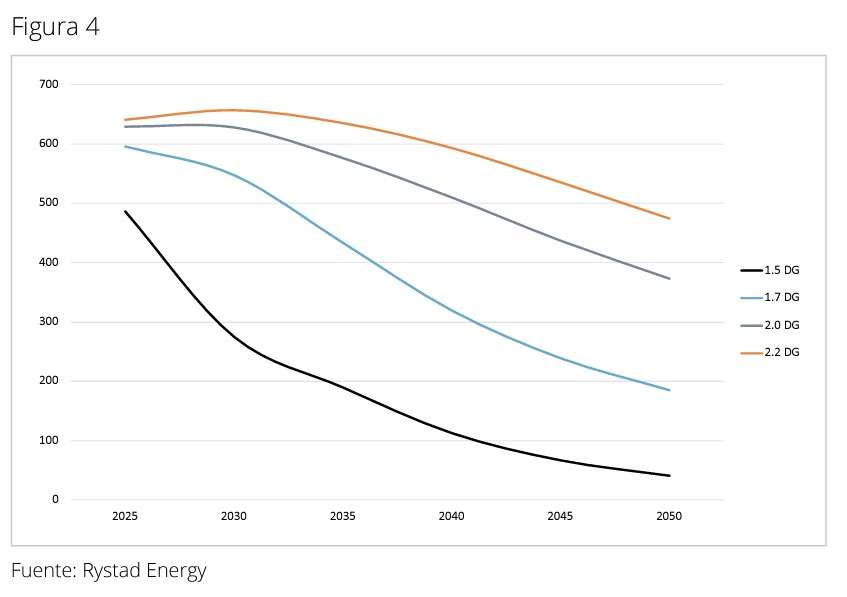
Even in the scenario with an average global temperature increase of 1.5 degrees, in which the demand for hydrocarbons declines rapidly starting from the next decade (Figure 4), the world needs to continue investing in exploration and production of hydrocarbons due to the high decline rate.
Investment in exploration and production needed according to different scenarios
Another extremely important element when considering the role of hydrocarbons in a just energy transition is energy poverty. According to data from the International Energy Agency, today the number of people without access to electricity in the world is 760 million and those without access to modern cooking methods is 2.3 billion. That is, almost 1 in every 4 people in the world. Reducing energy poverty should be a fundamental part of the global agenda for social development. Hydrocarbons, due to their versatility and high energy content, should be part of the solution to this serious global problem.
The role that hydrocarbons have and will continue to have in the energy transition involves certain relevant considerations in our region, Latin America, where we have important producing countries such as Brazil, Argentina, Guyana, Venezuela, Colombia, Trinidad and Tobago, and Ecuador. Our region represents about 71% of global hydrocarbon production. For these producing countries, the hydrocarbon sector is strategic, as it represents an important source of employment, tax revenues, and technology transfer. Therefore, it is important to understand how producing countries will need to adapt to the new reality in the sector that the energy transition will bring.
As the growth of hydrocarbon demand slows down and eventually begins to decline, competition among producers will increase. For the producing countries in our region to remain competitive in this new global configuration, they will need to focus on three relevant aspects. Greater efficiency in the exploration, production, and marketing of hydrocarbons will be key. Exploiting short-cycle production opportunities, which are more flexible and have shorter returns, will increase the competitive advantage of our countries. And finally, the energy transition will make carbon intensity in the production and marketing of hydrocarbons a differentiating factor among producers. Therefore, betting on clean processes, complementing with renewable energies, and reducing methane emissions will be another area where our producing countries can generate advantages.
 Colombian Association of Oil and Gas