
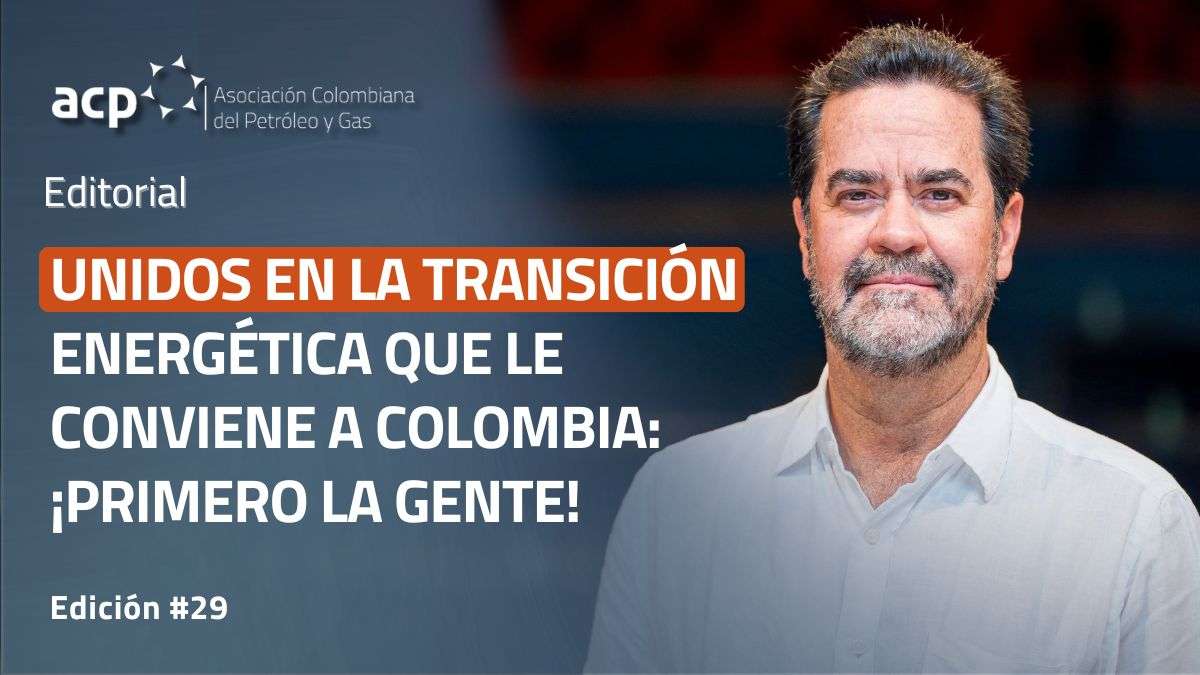
United in the energy transition that benefits Colombia: people first!
Let’s advance a fair, equitable, and sustainable energy transition, tailored to Colombia, ‘Colombian-style’, that modernizes the country.
The oil, gas, and liquid fuels industry is a pillar to lead it.
Colombia is a country in transition.
Since we became a Republic, our history has been one of moving from one transition to another. Recently, we have spent decades trying to transition from illegality and informality to economic formalization; from criminality to compliance with the laws; from armed conflict to the exercise of politics without weapons; from inequity to equity; from poverty to prosperity and general well-being; from centralism to greater regional autonomy; from the precariousness of our economic system to a formal, competitive, diversified, and modern economy; from a political system based on representative democracy to one complemented by mechanisms of direct democracy, in which we have yet to find a balance that protects and respects the rights of all citizens.
Within these transitions, there is the just energy transition that we must develop.
This last transition, the energy one, is as complex or more complex than the others listed: its definition and development include all components of public policy and touch the daily lives of all citizens in all sectors of the country, every day.
The conversation about that just energy transition today, when it is evident that the systematic decrease over the last 15 years in gas and oil reserves jeopardizes our energy security and self-sufficiency and the efficient supply of hydrocarbons in the coming months and years, must be framed within the set of transitions we are advancing, on which we have not yet built consensus on basic issues.
Therefore, it is essential to reach an agreement on the objectives of the energy transition and define what it is for and what it is not. What is its purpose?
For this conversation to be useful, it must take place from our reality and our aspirations. For Colombia, it would not be useful to start from premises that led rich and developed countries to define global decarbonization goals for 2050, nor to assume that we must copy the path of countries in the world that do not share our environmental, social, or economic reality: the transition is not about meeting goals; it has a higher purpose for society.
Colombia is a society with unsustainable levels of inequity, poverty, and illegality. It also has enormous natural resources and attributes of comparative advantages from which we can define a path to modernize the country.
Another basic question to define the transition route is: what is the ultimate goal of public policies? To maximize the welfare function of society, that is, to optimize the well-being of the people. People first! The ultimate end of public policies is us, the citizens, and our well-being. That welfare function is unique to each society, to each economy: the transition is not about copying external formulas that are inapplicable in Colombia in content and pace. The transition is not a hasty leap into the void.
Maximizing well-being involves achieving three objectives from the just energy transition:
- Energy transition
- Economic transition
- Social transition
The energy transition aims to complement our energy sources by diversifying the supply matrix with increasingly low-emission elements, and that meet an adequate balance between energy efficiency, economic efficiency, and mineral efficiency. It also involves modifying our systems of production, consumption, and disposal to minimize unwanted impacts on ecosystems, across all sectors and all value chains of the economy.
The above requires resources and technologies that we will have to adopt.
The economic transition seeks to reduce the dependence of our local and national economies on hydrocarbons. The way to do this, clearly, is not by eliminating hydrocarbons, as some intend. It is not by shrinking the pie to impoverish ourselves.
It is the opposite: it is by strengthening the oil, gas, and liquid fuels sector, which is a solid foundation for our economic, fiscal, exchange rate stability, and resource generation for the regions, with two clear objectives: the first, to generate the resources to finance the gradual adoption of technologies that facilitate the advancement of the energy transition. The second, to provide the resources to achieve the diversification of regional economies through investments that increase the competitiveness of productive sectors, formalizing local economies.
That function of well-being is unique to each society, to each economy: the transition is not about copying external formulas that are inapplicable in Colombia in content and pace. The transition is not a hasty leap into the void.
We cannot cover the sun with our hands: poverty is the greatest enemy of the environment.
Public policies that increase poverty levels under the pretext of protecting ecosystems destroy them more quickly.
Within the framework of an energy transition policy applied to the Colombian context, the strengthening of the oversight system for royalties generated by the hydrocarbons sector must be prioritized.
A fundamental starting point is that we all ensure the proper investment of royalty resources to guarantee that their only destinations are the improvement of the quality of life of communities and the financing of projects that contribute to regional and national competitiveness strategies, benefiting the development and progress of the departments of our country.
Social transition means reducing the levels of inequality that we have today, which are among the highest in the world.
The social transition, for Colombia, for us, is the most important desired outcome of a just energy transition.
Social transition means reducing the levels of inequality that we have today, which are among the highest in the world. It also means ending poverty. Colombia, with monetary poverty levels of 33.1% and millions of people in conditions of misery, must give the highest priority to resolving this humanitarian drama that we have unnecessarily created with bad public policies and shortcomings in our economic and public administration systems.
To achieve social transition, we must intelligently use the resources generated by the hydrocarbons sector. These are the key to a ‘Colombian Transition’, aimed at modernizing the economy and the well-being of the people.
If we wither this sector today, what are we going to live on?
Those who argue that hydrocarbons must disappear now have a position that is impossible to justify in economic and social terms. That is not a supported or sensible stance. It is insensitive to our communities and irresponsible towards the most needy citizens and the potential for transformation that we have in Colombia.
Respecting all opinions, we are clear that it is essential to find a balanced and gradual route based on basic consensus that allows us to make an energy transition in the Colombian way: just, equitable, and sustainable, starting from our potential and the need to be self-sufficient and have energy sovereignty.
Let us not repeat the mistakes we have made in other transitions, which we have not been able to advance over the last few decades.
Therefore, for the energy transition, from the Colombian Association of Oil and Gas, we invite you to maintain a respectful and clear dialogue, organized, broad, and open, that brings together companies, communities, academia, and national, regional, and local governments in an exercise to continuously improve the roadmap that incorporates a joint vision in terms of objectives, timelines, expectations, and innovative initiatives to advance in this matter.
This process, and without room for false dilemmas, must be accompanied by the effort of companies in all sectors of the economy, to decisively address climate change and the transition to cleaner energy sources. The above is a reality, and part of our work has been to make visible social and environmental initiatives that we already lead and that mark the steps towards that goal of building a sustainable future for Colombia.
I welcome you to this new edition of the ACP Magazine that will focus on the analysis of the ‘Colombian energy transition’, from the perspective of our industry, and that invites experts from the hydrocarbons and energy sector, in the country, in Latin America, and the world, to share their assessments regarding the great challenge we face.
We must unite, reach an agreement, and formulate transformation processes that allow us to advance, from a perspective that prioritizes solutions to the problems that still persist. The companies in oil, gas, and fuels are undoubtedly allies of the country on this path that we must travel together, organized, with a drive for change and transformation, a sense of reality, and a future perspective.
Those who argue that hydrocarbons must disappear now have a position that is impossible to justify in economic and social terms.
 Colombian Association of Oil and Gas