
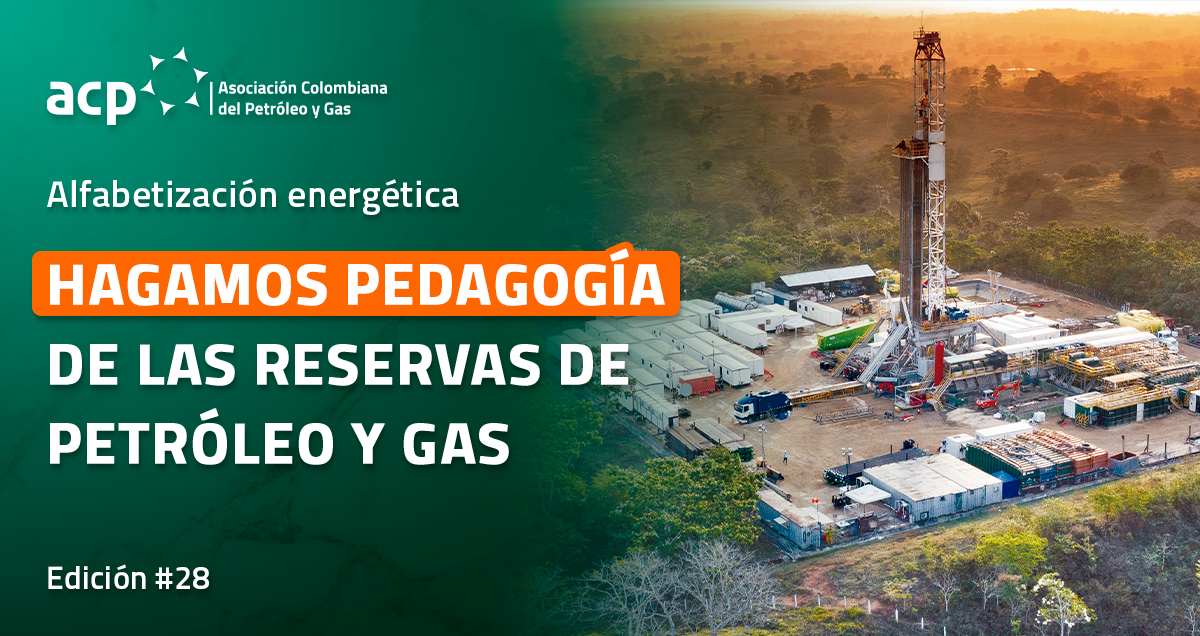
What are hydrocarbon reserves and how are they calculated? According to the National Hydrocarbons Agency, they are the stocks of oil and gas that can be commercially used through extraction and meeting a series of conditions.
Much has been said in Colombia about the importance of increasing its oil and gas reserves to guarantee the local supply of these vital energy sources for the economy, development, and the well-being of national society. However, little is known about the work behind the reserves, their importance, or the actions of the public sector and companies that, day by day, promote opportunities through hydrocarbons in the national territory.
To begin with, what are hydrocarbon reserves and how are they calculated? According to the National Hydrocarbons Agency (ANH), the authority responsible for managing and promoting the use of the country's hydrocarbon resources, they are the stocks of oil and gas that can be commercially used through extraction and meeting a series of conditions.
These reserves are divided into proven (90 percent probability of recovery), probable (50 percent), possible (10 percent), and contingent resources, which would be those hydrocarbons that may be potentially recoverable but are currently not considered commercial.
And knowing this, why is it important to know the reserves? Basically, this is information that is of interest to all Colombians because the resources of the subsoil are potential for a better quality of life, the economic and social development of the country, as well as closing gaps through the certainty of producing oil and gas, and projecting the revenues and contributions they can offer to the national economy.
In this regard, Canacol Energy states that “knowing hydrocarbon reserves is of vital importance for any country, as knowing the volume of hydrocarbons available allows for planning how these reserves or volumes will be consumed in the future, and thus the extractive industry can provide in an orderly and planned manner the fuels that drive the economies, the well-being, and prosperity of their inhabitants.”.
But, in all this, what role do companies play in the reserves? For Armando Zamora, former president of the National Hydrocarbons Agency and sector expert, companies are key, as “they are the vehicles that make future production effective, they are the ones that ensure the necessary investment and the physical production capacity. Without companies, reserves do not exist as such, but as resources discovered in the subsoil, where they have no value.”.
Now that it is known why they are important, one can understand a little more the discussion about the need to increase and replenish them. Replacing the resources used to produce the fuels that bring food to the table or allow us to move for leisure or work, or the gas that helps heat the shower water in the mornings or turn on the stove to make breakfast, is of vital importance if one wants to continue enjoying and taking advantage of these activities.
In this, exploration and exploitation are indispensable, as they are vital stages in the production chain and will allow for the discovery and evaluation of the possibility of commercial exploitation of the resources. “Without exploration, there will be no new reserves; without reserves, there will be no energy sovereignty; and without sovereignty, Colombia's future will not be guaranteed,” says Luis Guillermo Acosta, executive director of Acipet.
Precisely, there the public sector has a highly relevant role, as it generates the necessary conditions for investment to come through companies, while providing capital entry through incentives, policies, and legal security, allowing companies to allocate their technical expertise and financial muscle in exploration processes and subsequent production, just as was done in the cycles of the Permanent Area Assignment Process (PPAA) promoted in previous years by the ANH and the Ministry of Mines and Energy.
The importance of oil and gas production in the country is undeniable, not only because hydrocarbons are used in many daily activities, but also because oil is Colombia's most important source of foreign exchange.
Now, knowing how important reserves are across the board in Colombia, how are they replenished so that the country can have them and their benefits? Replenishment goes hand in hand with what was said before: exploration. Each company promotes and drives the replenishment of reserves through successful exploratory campaigns, adding hydrocarbons from discoveries, reclassifications, or technical additions that compensate for the use of the resource. In other words, by adding new reserves, it is guaranteed that the country has oil and gas to use, as the piggy bank and savings run out without further incorporations.
That said, the importance of oil and gas production in the country is evident, not only because hydrocarbons are used in many daily activities, but also because oil, for example, is Colombia's most important source of foreign exchange. In the words of Armando Zamora, “this industry prevents us from having to import the hydrocarbons that the economy needs. Without its contribution, it would be the most important item of imports, and without other sources of foreign exchange to pay for them, it would drive the value of the peso to unprecedented levels, increasing the costs of gasoline or electricity.”.
Knowing how important reserves are across the board in Colombia, how are they replenished so that the country can have them and their benefits?
And not only this, but it also promotes and drives the country's energy transition, which, as the former president of the ANH, Armando Zamora, rightly points out, “will be faster and more robust if we use the revenues from hydrocarbons to sustain the economy while the transition takes place.”.
 Colombian Association of Oil and Gas