
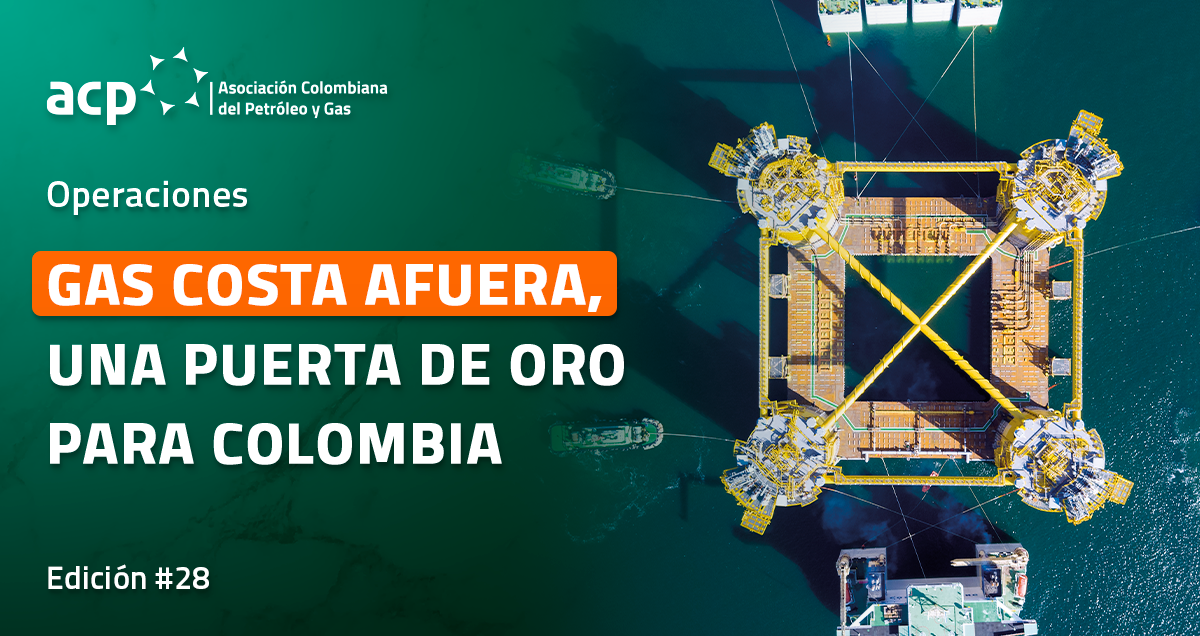
The future seems to smile upon the country in gas matters, although several experts agree that the utilization of these resources depends on factors such as exploration and exploitation, as well as the promotion of the sector and its transportation to users.
The wealth that Colombia possesses is undeniable. The country has a privileged location that will allow it not only to be a power in energy transition but also to have the hydrocarbon resources to drive and consolidate that transition, supported by the development and economic opportunities that oil and gas can provide to successfully diversify the energy matrix, in addition to closing the gaps that the territories require.
While the country has made significant advances in regulatory matters and the development of renewable energies, this is a long-term plan that will need the support and complement of existing resources to ensure the proper transition in the years to come, which is why hydrocarbons are and will continue to be, as the International Energy Agency (IEA) has well explained, a fundamental piece in this entire process.
In this regard, Colombia is optimistic thanks to its offshore gas resources, which can guarantee prosperity and development through one of the energy sources of the transition. And it is not surprising to have such optimism, as, in the middle of the year, companies Shell and Petrobras, in partnership with the state-owned Ecopetrol, announced significant findings in Gorgon 2 and Uchuva 1, a fact that supports the golden opportunity found in the Colombian Caribbean.
“The potential offshore natural gas resources are becoming increasingly relevant for energy security and a just energy transition. For this to be a reality, it is essential to work together on the development of regulatory mechanisms that allow this gas to be competitive for all Colombians. Likewise, we must promote the development of transportation infrastructure, which is so necessary to connect the entire national territory. The reliability of the system is key,” says Ana Duque, president of Shell in Colombia, Central America, and Hispanic Caribbean.
In this regard, Ecopetrol has stated: “these exploratory successes confirm the Caribbean as a gas province of great material potential and sufficient capacity to meet demand, contribute to energy sovereignty, and mitigate the risk of shortages. These findings are joined by previous discoveries that are still under evaluation or maturation.”.
Optimism grows even more when considering the existing potential in the area, as experts say this could guarantee the country's energy self-sufficiency. While Ecopetrol claims that the resource in the region is vast across different blocks and clarifies that the figures “will be refined as delimitation drilling progresses,” actors like Promigas and Acipet indicate that it could even reach 30 trillion cubic feet (TCF).
This would allow Colombia not only to avoid dependence on external resources, subject to the volatility of the international market, as is happening in Europe, but it could also ensure that Colombian families have gas from their own sources in their homes, at a competitive cost, as stated by Luis Guillermo Acosta, executive director of Acipet.
“It is vital to confirm the offshore gas potential through drilling wells that allow for the delineation of deposits and estimation of proven reserves, which, as resources today, could be on the order of 10 times the current reserves of the country. Additionally, maintaining and extending the time of gas self-sufficiency, avoiding imports; more royalties and fiscal revenues,” assures Acosta.
Thus, the future seems to smile upon Colombia in gas matters, at least from the perspective of findings and potential. However, several experts agree that the utilization of these resources depends on factors such as exploration and exploitation, as well as the promotion of the sector and its transportation to users.
For Promigas, for example, one of the biggest challenges is ensuring the supply of natural gas in the medium and long term, not only due to reserve levels but also because of rising prices and restrictions on supply to unregulated demand. “It is necessary to firmly maintain the decision to continue exploring our own basins, developing reserves as long as they are efficient and economical, and to keep the possibility of importing gas open when the domestic market requires it to ensure the continuity of service,” they point out.
It is evident that the country has a golden opportunity in gas, but it depends on several factors, such as well-directed public policies to promote and take advantage of it. The transition will need gas as one of its star fuels to consolidate, promoting renewable energy through royalties, while also contributing to the fight against climate change, encouraging lower CO2 emissions and ensuring the supply for the more than 10 million households that currently use it for cooking, as well as for the hundreds of industries that have it as their main source in production.
 Colombian Association of Oil and Gas