
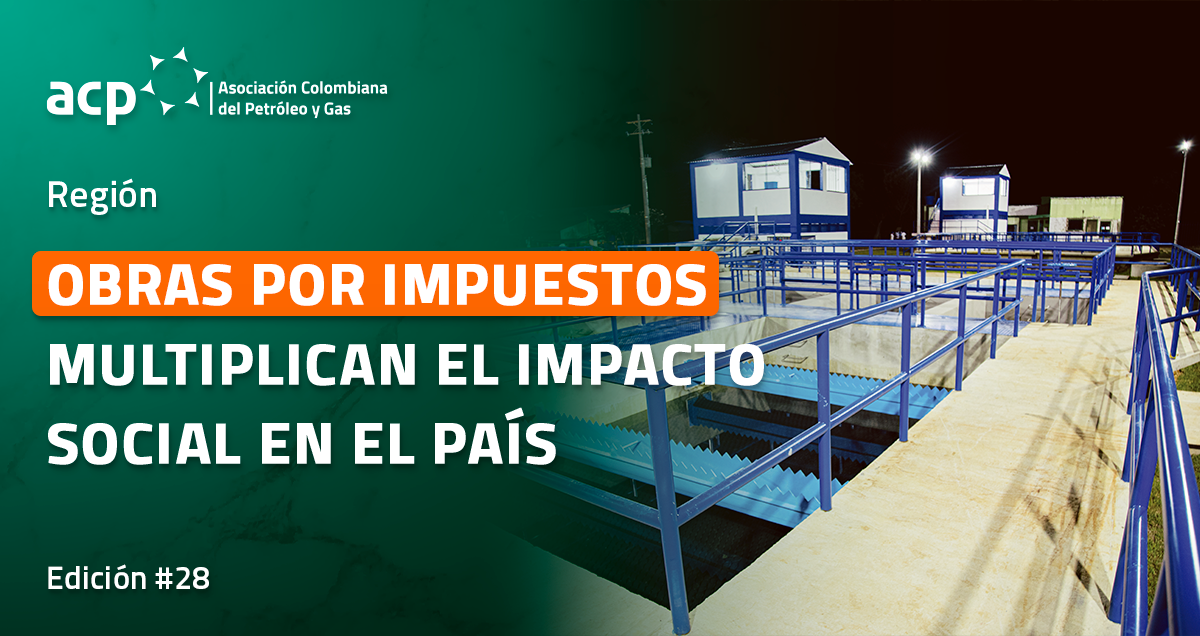
According to the Agency for Territorial Renewal and the National Planning Department, companies in the hydrocarbons industry have executed more than 107 projects, totaling nearly one trillion pesos, since this mechanism was implemented.
Edmer Tovar Martínez, @edmertovar
Many companies have adopted the successful social investment model of Works for Taxes, which focuses on municipalities located in the Most Affected Areas by Armed Conflict (Zomac), and in those with Territorial Development Programs (Pdet). The reason: in those urban or rural populations, companies embraced this payment option of up to 50 percent of the income tax, through the execution of social development works.
While the initiative applies to all sectors, it has been adopted primarily by companies in the hydrocarbons industry. The figures from the Agency for Territorial Renewal (ART) confirm this: the Ecopetrol Group and its subsidiary Hocol, as well as other companies, including Gran Tierra Energy, Parex Resources, and GeoPark, are examples of the sector's participation in the execution of Works for Taxes projects, under which more than 107 projects have been executed, totaling investments exceeding 963.139 million pesos in the departments of Tolima, Arauca, Putumayo, Cesar, Sucre, Casanare, Bolívar, Meta, and Antioquia, mainly; that is, 50 percent of the total projects executed by the major taxpayers who have adopted this mechanism.
The projects carried out so far have focused on photovoltaic solar solutions, roads, aqueducts and sewage, and education (infrastructure, furnishings, provision of furniture and digital technology equipment). All are carried out with local labor, high standards of quality and sustainability, agility and transparency, as well as efficiency in resource management.
There are many success stories of the Works for Taxes mechanism, but here we will mention only a few:
Gran Tierra Energy
With Works for Taxes, the company has executed four projects for more than 14.100 million pesos in improving tertiary roads and education in Putumayo, in the municipalities of Mocoa, Orito, Puerto Asís, Puerto Caicedo, Puerto Guzmán, Puerto Leguízamo, San Miguel, Valle del Guamuez, and Villagarzón, which have benefited nearly 30,000 people.
The company has provided kitchen equipment such as refrigerators, freezers, and ovens, as well as tables and chairs for 152 school cafeterias, intended for more than 12,000 students and teachers. This has meant food security for local students.
With these initiatives, the quality of life of people along this route and the local economy have been positively impacted, with lower transportation costs for cargo and passengers, road safety, and ease of marketing agricultural products and livestock.
In addition, the company is advancing in ten new Works for Taxes projects for 2023 and 2024, which have been chosen by local communities and will be carried out in Villagarzón, Mocoa, Puerto Asís, Orito, and Valle del Guamuez, to benefit more than 22,000 people. The investment amounts to 63.000 million pesos.
GeoPark
The company has executed two Tax Works projects for more than three million dollars in the Pdet Putumayo area: Mocoa, Orito, Puerto Asís, Puerto Caicedo, Puerto Guzmán, Puerto Leguízamo, San Miguel, Valle del Guamuez, and Villagarzón. According to the latest available information, the beneficiaries exceed 8,300 children and young people, who benefited from the provision of furniture and equipment for the ICBF Child Development Centers in Putumayo.
The financed projects are related to the provision of kitchenware for more than 160 school restaurants of the institutions and educational centers in the municipality of Puerto Guzmán, Putumayo, as well as the acquisition and replacement of supplies for the Child Development Centers (CDI) within the framework of the ICBF early childhood program.
Ecopetrol Group
In the last five years, Ecopetrol and its subsidiaries ISA, Hocol, Cenit, Llanos Pipeline, and Bicentennial Pipeline have been approved for 58 projects in road infrastructure, water and basic sanitation, photovoltaic energy solutions, and public education worth 553 billion pesos, benefiting more than 1.6 million inhabitants in 72 municipalities across the country.
The year 2022 was one of the most prolific years for projects of this type. The ART, the DNP, and the ministries of Transport, Mines and Energy, Housing, and Education approved a total of 16 projects financed under the Tax Works modality for Ecopetrol Group to execute between that year and 2023, benefiting 128,000 people in 30 Zomac municipalities in the departments of Arauca, Casanare, Putumayo, Bolívar, Meta, Sucre, Tolima, Cesar, and Antioquia.
These initiatives accelerate the energy transition led by the company (photovoltaic energy solutions for rural users), close gaps in road infrastructure (paving and improving roads), support public education (infrastructure, digital technology, furniture, and kitchenware for educational institutions), and access to drinking water and basic sanitation (distribution networks).
Hocol
In 2018, the company began working on a pilot project, and in the last six years, it has executed Tax Works projects in Antioquia, Tolima, Sucre, La Guajira, and Valle del Cauca. The first project was approved in 2019, and its execution, worth 1.66 billion pesos, began in 2020. Hocol has designed and executed works in the sectors of education, transport, and energy, in construction, improvement, remodeling, provision, and supply of desks, tables, lockers, boards, chairs, and kitchenware for the School Feeding Program (PAE).
Between 2018 and August 30, 2023, the company has executed 21 projects for more than 76.227 billion pesos and has benefited nearly 360,000 people. In the current year, Ecopetrol's subsidiary broke the record in Tax Works projects. It was approved for 15 projects for nearly 50 billion pesos. Moreover, for 2024, it plans to execute projects worth double that of 2023, that is, approaching 100 billion pesos.
Parex Resources
Through Tax Works, Parex has executed 15 projects for 214 billion pesos, according to the ART. Among these, two stand out for more than 30 billion pesos, to bring drinking water to 33,000 people in Tame, Arauca, and another executed in Aguachica, Cesar, for 14 billion pesos for the provision of technological supplies to 14,000 students.
Recently, Daniel Ferreiro, president of Parex Colombia, stated that since 2018, when the execution of their first Tax Works Pdet project began, “we became convinced that with this type of project we demonstrate that Parex Resources and the industry are much more than oil.” The company has also invested in tertiary roads and hospital and educational infrastructure.
What does Tax Works consist of?
It is the mechanism that allows large taxpayers (those who pay more than 1.425 million pesos annually in income tax) to invest up to 50 percent of their tax obligation in the execution of social development projects in the Most Affected Areas by the Armed Conflict (Zomac), or in municipalities that have Territorial Development Plans (Pdet). The initiatives must focus on the sectors of road infrastructure, education and public health, drinking water and sewage, energy, rural public goods, climate change adaptation and risk management, payments for environmental services, information and communication technologies, and productive, cultural, and sports infrastructure.
Tax Works is not a tax incentive for the private sector, but an alternative for paying income tax, which can be used by companies from any economic sector in the country. By 2022, a total of 95 companies had joined this program, according to data from the DNP and the ART.
 Colombian Association of Oil and Gas