
For the proper development of each phase of the activity, companies require certain goods and services. On some occasions, and due to the specificity required, these are purchased at the national level. However, parallel to the development of the activity in the operating territories, purchases at the regional level have also increased, and local suppliers have been strengthened.
Indeed, over the last five years, the sector has invested more than 50 billion for the strengthening of local supplier development, allowing local companies to have the technical capacity and necessary experience to ensure the development of operations. This has allowed, since 2013, companies to make purchases of more than $54 billion in the operating areas.
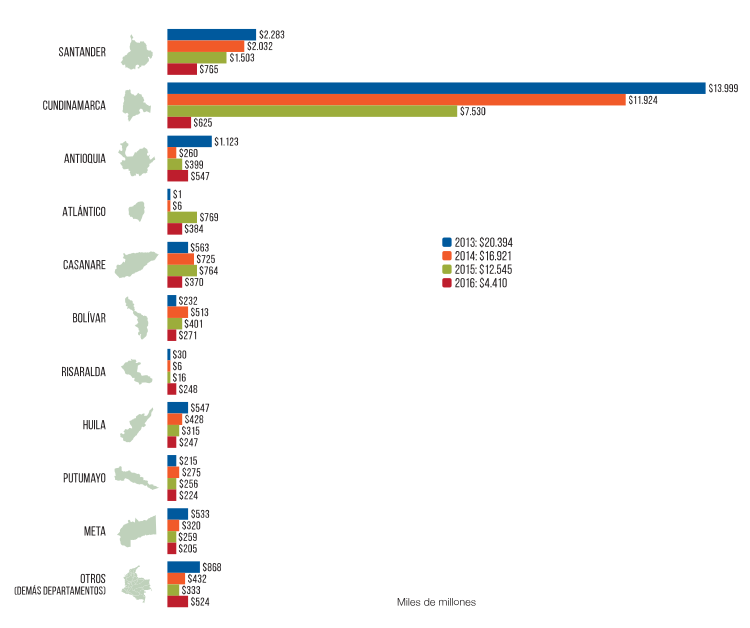
However, since 2013 there has been a progressive decrease in the amounts of purchases of local goods and services. In 2013, purchases were close to $20 billion, while in 2014 this figure decreased to $17 billion, in 2015 to $12.5 billion, and in 2016 exceeded $4 billion. This decrease has had some collateral effects in the regions, affecting not only the direct value chain but also trade and employment, as well as other sectors related to tourism, transportation, and construction.
As can be seen in graph 28, at the regional level, as in previous years, in 2016 the departments where the largest number of purchases were made were Santander and Cundinamarca, where purchases of $765 and $625 billion from local suppliers were made, respectively.
Although there is a decrease of more than 50% in the case of Santander and more than 100% in Cundinamarca, these declines are mainly due to the fact that the technology contracted in Bogotá for the exploratory phase suffered a substantial drop because companies focused on production activities rather than exploration activities.
However, when reviewing the behavior in departments such as Atlántico, Casanare, and Bolívar, there is a decrease of almost 50%. Meanwhile, in departments such as Huila, Putumayo, and Meta, despite the evidence of a decrease, it does not exceed 15% compared to 2015.
 Colombian Association of Oil and Gas
