
Road infrastructure is important for generating regional economic growth. The existence of roads guarantees not only communication between populations but also commercial exchange and increased productivity. The hydrocarbon industry is committed to leaving installed road capacity in the areas of operation that allows for regional development and local competitiveness.
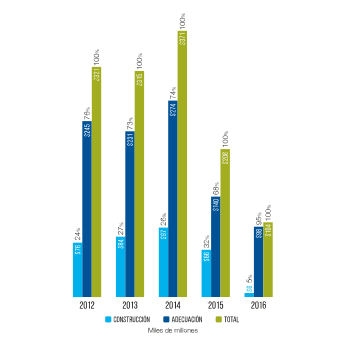
In the last five years (2012 -2016), the hydrocarbon industry has directly invested nearly $1.4 trillion in the construction and adaptation of roads in the operational areas of the sector. Although some of these investments are related to the need for the necessary infrastructure for the development of operations, they have also allowed for increased competitiveness, growth, and communication among communities in areas with scarce public investment.
According to the report from the Economic Commission for Latin America (ECLAC), investment in road works and infrastructure is a vital factor for increasing economic growth. Indeed, the development of road infrastructure generates an increase in local productivity, as it contributes to the exchange of information, products, encourages trade, and reduces production and transportation costs.
The investment made by companies has sometimes been in road sections where safe transport routes did not previously exist and in places where road investment was focused on primary roads. In the last five years, nearly $330 billion has been invested in road construction and nearly one trillion pesos in adaptation. This investment has been focused on the adaptation of tertiary roads that connect municipal capitals with their rural areas or connect rural areas with each other.
Regarding investment in road construction in 2016, there was a decrease of more than $100 billion compared to 2015 and $270 billion compared to 2014. Specifically, in 2016, investment in road construction was close to $6 billion, of which 53% was developed in access roads and the remaining 47% in tertiary roads.
The most significant decrease occurred in the investment categories for road construction, where there was a reduction of nearly 91% between 2015 and 2016. This is mainly due to the amounts allocated for road construction being related to the necessary infrastructure for the construction of adaptations in the production stage, and as has been noted since 2014, exploratory activity and development and production wells have decreased.
Investment in road adaptation, as in previous years, in 2016 was focused on the development of improvement and maintenance activities for the roads. Nearly $98 billion was invested, lower than the amounts recorded in 2015 and 2014, when investments close to $140 billion and $274 billion were made, respectively.

Of the total investment in road adaptation made in 2016, 37.8% of the resources were allocated to the adaptation of secondary roads, which are those that connect municipal capitals with each other and/or connect a departmental road with a main road. 35.2% was allocated to the adaptation of tertiary roads, 26.8% to access roads, and the remaining 0.2% to primary roads.
 Colombian Association of Oil and Gas
