
The new oil spill is due to natural causes and there are many more in the country
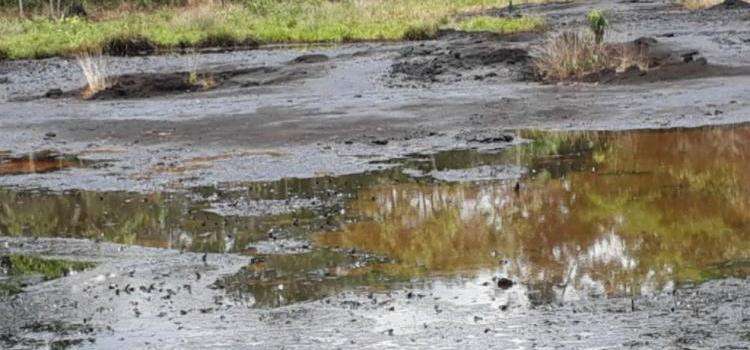
A possible oil spill alerted in El Carmen de Chucurí (Santander) has generated intense controversy again.
This weekend a new scandal related to oil began to gain momentum: a supposed oil spill in the municipality of El Carmen de Chucurí (Santander) started to ignite the controversy again and prompted dozens of criticisms towards Ecopetrol. “After the seismic activity of @ECOPETROL_SA in Carmen de Chucuri, Santander, the ecosystem was left with irreparable damage,” wrote Juan Camilo Caicedo on Twitter, who presents himself as an activist, columnist, digital strategist, and collaborator of the portal Con la Oreja Roja.
“This is the development they want to bring to Tolima. Images taken by a community leader from Carmen Chucurí (Santander) this afternoon. Pollution caused by a seep in Campo 27 of @ECOPETROL_SA,” noted another user who accompanied her text with photos showing a pasture stained with crude oil. They were not the only ones who reproached that, after what happened weeks ago, the country had to face another “environmental disaster.”.
Was it true? Was there another failure by Ecopetrol? Was Santander going to have to face another oil spill again? (Read The explanation of the oil spill in La Lizama according to Ecopetrol)
After the images left by what happened in La Lizama and after some mistakes by the company and state entities were exposed, it seems normal that any oil stain would alter the mood of Colombians. And sometimes, it may also be normal for journalists to get carried away by that current and by the scandal.
What Ecopetrol clarified was that it was not a new spill, as some people wanted to make it seem. “It is a natural hydrocarbon seep that has been reported to the environmental authorities since 2012. There is the San Luis Field, where four more seeps have been reported that are not related to oil wells,» Adrián Antonio Camargo, production leader of Ecopetrol's Marine Management, told RCN Radio.
The first official who answers the phone at the Mayor's Office of El Carmen de Chucurí (Santander) says she does not know what spill I am talking about; that she has no news so far. The second one does confirm it: there is an “oil seep” on the main road leading to Barrancabermeja, about 45 minutes from the town by motorcycle. However, Gilberto Camacho from the Planning Secretariat assures that the oil puddles on a piece of savanna are the same as five years ago. In 2012, he says, he passed by there and there were already stains. Are there any culprits? Camacho says he has no idea and reiterates that he does not dare to give technical details, as it is not his area. “I do not know that case in depth. I cannot say anything more.”.
Nini Johana Cárdenas, a community leader, is also not certain that the company was responsible, but she is concerned that in that area of about one hectare, there is oil and some calves are getting stuck in it. “The residents say that this phenomenon had not occurred before they did seismic activity. In addition, officials from the National Hydrocarbons Agency (ANH) and Ecopetrol have come and they do not help us with the problem. So, who is responsible?” she asks.
It is difficult to know if what Nini Johana suggests is true without having technical studies to prove it, but the ANH has already visited the site and gave its verdict. “At the site of the seep, there are four natural points of hydrocarbon seepage, documented in the Environmental Management Plan.”.
Is it possible for that to happen? Could it be a natural phenomenon? A geologist from the National University, with a PhD in seismic engineering, has several arguments that help to understand this fact. Although he prefers not to be quoted because he believes it is up to state entities to respond to these controversies and because he prefers to stay out of these discussions during election time, he explains that it could indeed be something natural.
Technically, this expert says, what may be happening is known as seeps and there are many places in the country where they occur. “It can happen when they are going to build a road or when there is a very strong winter season that causes hydraulic overpressure to mobilize the oil. It also tends to happen when civil works are carried out, when there is an earthquake, and even when there are drillings. It is nothing strange, but it is also not something we should worry about too much. It is true that when this happens, the waters and animals get contaminated, but that material degrades over time and, little by little, the bacteria eat it away,” he explains.
In fact, on the ANH website, there is a map titled “Seeps.” It is from 2010 and shows that in a good part of the Caribbean coast there are many of these spots. They are found in Valledupar, Córdoba, Bolívar, Atlántico, in the north of Sucre, and even in the northwest of Antioquia. There are also in Cundinamarca, Huila, Tolima, Boyacá, and of course, in Santander. In several of these places, there are not only oil seeps. There are also gas seeps.
Now, beyond this controversy caused by the La Lizama spill, there is a deeper issue that worries the inhabitants of EL Carmen de Chucurí. For quite some time, they have been waiting to hold a popular consultation to decide whether or not they want extractivism in their territory. It has already been approved, but the Ministry of Finance has stalled it. They were told, as has happened on other occasions, that there was no money to print the ballots.
Environment Editorial https://www.elespectador.com
 Colombian Association of Oil and Gas