
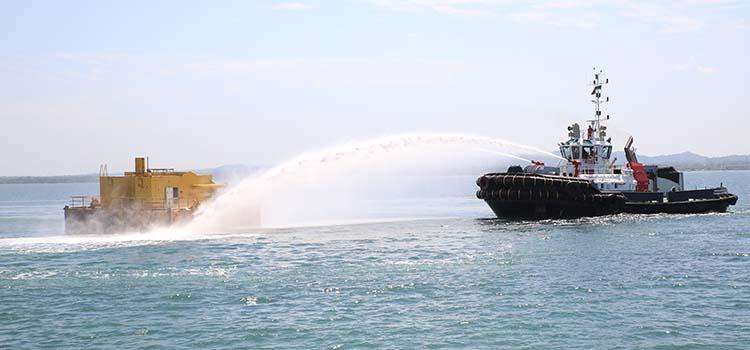
The Morrosquillo Gulf Strategy, integrated by Cenit, Ecopetrol, Ocensa, Bicentenario Pipeline, and Pipelines of Colombia, launched the third phase of the Diaspora program, which includes the construction and sinking of 50 artificial reefs in the waters of this area of the Caribbean.
In the development of this third phase, between December 2017 and the beginning of 2018, five artificial reefs have been planted using decommissioned naval artifacts, such as the old monobouys TLU1 and TLU3 and their respective relief barges, and the Morrosquillo Gulf pontoon, which were used at the Ecopetrol Maritime Terminal in Coveñas.
Before planting, the artifacts were inspected by the Regional Corporation Carsucre and authorized by the Port Captaincy -DIMAR-, organizations that endorsed their conversion to artificial reefs.
Diáspora is an inter-institutional initiative aimed at recovering biodiversity and productivity in the Morrosquillo Gulf, through the construction and planting of artificial reefs on the seabed and the recovery of mangroves.
Background
Studies conducted since 1985 on the marine ecosystem of the Morrosquillo Gulf led to the signing of the Ecopetrol agreement in May 1999, with the National Institute of Fishing and Aquaculture - INPA- and Carsucre, to develop the pilot project with two artificial reefs constructed from decommissioned steel pipes.
The two reefs were installed in October 2000 in marine waters of the gulf. One was planted south of the municipal head of Santiago de Tolú and the other in front of the township of Coveñas, near Puntepiedra.
In 2007, in a first phase, thanks to the excellent results of the first two reefs, 20 more reefs were planted. This phase involved Ecopetrol, Carsucre, the Corporation of the Valleys of Sinú and San Jorge- CVS-, the Sucre Governor's Office, the Argos Foundation, SENA, the mayors of Tolú, Coveñas, and San Antero, and organized communities of artisanal fishermen.
The second phase of the Diáspora Program took place between 2010 and 2014, with the planting of 30 new artificial reefs. In 2017, a signaling project was carried out with 13 buoys to identify the sites where the reefs are planted, an activity supported by Carsucre and COMPAS.
Along with the planting of the 50 artificial reefs, the third phase of the program includes a component to strengthen fishermen's organizations on issues related to nature tourism and underwater ecotourism, as a productive alternative for communities.
Benefits
The planting of the reefs has improved the quality of life for fishing communities and the productivity of the marine ecosystem in the gulf. It has also increased the number of marine species in the area, with the presence of eight (8) threatened species.
In this way, the reefs of the Diáspora Program rank among the most productive in the Colombian Caribbean and position themselves as the main fishing ground used in the Morrosquillo Gulf.
It is noteworthy that the Diáspora Program was replicated at the Pozos Colorados Terminal, in Santa Marta and at the Port of Tumaco, with positive results that have earned it national and international recognition, among which stand out:
- First place in the National ACIPET Award for innovation in the environmental category
- First place in the ACCENTURE Award in the socio-environmental responsibility category.
- Nomination and finalist for the World Innovation Award from the ONS in Norway.
 Colombian Association of Oil and Gas