
A century of history is just the starting point to face the challenges that arise in a changing world and a country where the hydrocarbons sector has played and will play a predominant and positive role in the development, energy security, and progress of Colombia.
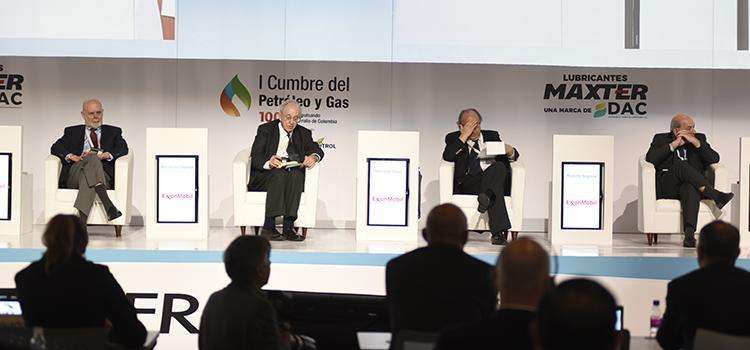
The 100-year conversation «Presence of the oil and gas industry in Colombia from a historical perspective» opened the I Oil and Gas Summit, under the gaze of specialists Malcolm Deas, historian, Fellow of All Souls College at the University of Oxford, Rodolfo Segovia, historian and former president of Ecopetrol, and Fernando Cepeda, doctor in Law and Political Sciences from the National University, who not only reviewed the most important milestones of this sector but also highlighted the challenges it faces as it approaches another century based on the evaluation of that experience.
The 19th century was a time of changes and revolutions, recalls Fernando Cepeda, doctor in Law and Political Sciences, where around 1902 the Thousand Days« War was ending and around 1903, Colombia lost Panama, an event in which the United States played a vital role in the process. In that scenario, an industry was born, which Rodolfo Segovia, historian and former president of Ecopetrol, locates at the Turbaco well in 1911, drilled by Exxon near Cartagena, a fact that Fernando Cepeda emphasizes as a milestone in which it must be evidenced that the people of Cartagena were the first to take an interest in it. Over these 100 years, the oil and gas industry has defended its interests as it should and has positively evolved in the company-union relationship, according to Rodolfo Segovia's concept. »Today the unions do their job well done and that is demonstrated by the generous convention signed with Ecopetrol, where these associations are truly defending the interests of the workers," says the historian.
But just as it has evolved being a key part of the country's development, new challenges must be faced today: «the bureaucratic adversaries with ultra-ecologism that seek to eliminate oil, because according to them, it contributes to the greenhouse effect; groups like the National Liberation Army (ELN), dedicated to extorting the industry and blowing up pipelines, and the urgent need for the industry to educate Colombians about its positive value in development. Although there are passionate speeches about fracking and the ecological threat, which I respect, I think the explosions by the ELN and illegal mining do more harm,» asserts Malcolm Deas, historian, Fellow of All Souls College at the University of Oxford.
To this, Fernando Cepeda adds that the ELN has been a «tube addict,» referring to the multiple explosions in the supply networks that have caused significant natural disasters and that the International Criminal Court will revisit the issue and take action.
Furthermore, in a scenario that has changed with the peace process, the Oxford specialist suggests, new perspectives open up for a different economy, where the oil industry will have a greater role and its enormous responsibility to educate about its actions and its contribution to the development and progress of Colombia.
 Colombian Association of Oil and Gas