
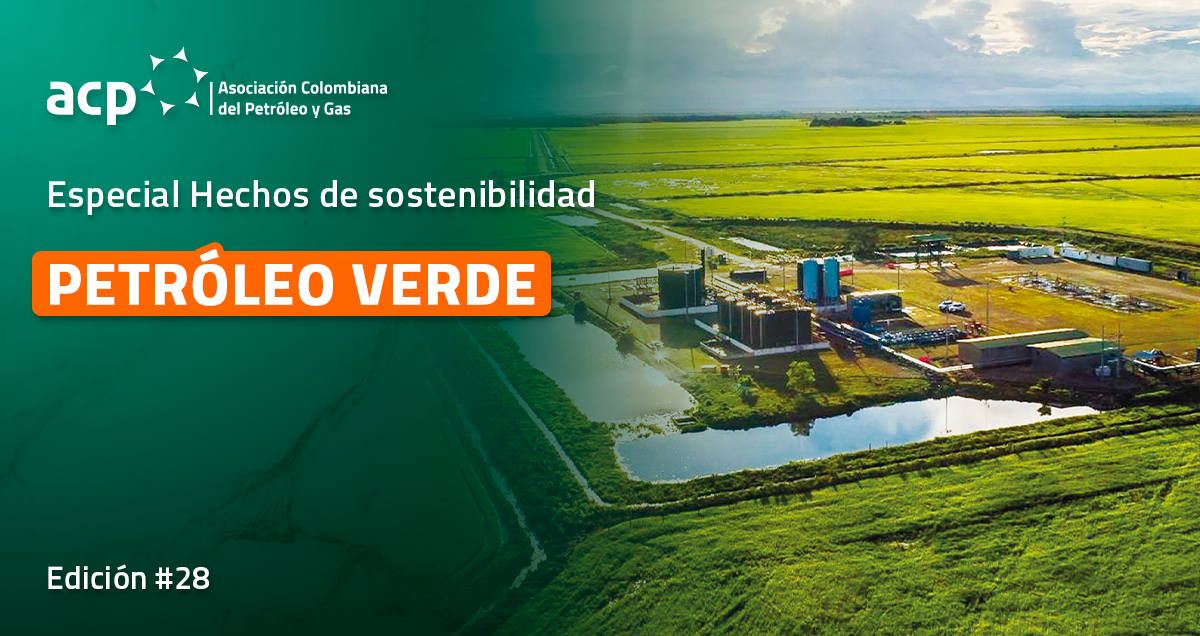
As the world advances actions to mitigate and contain climate change, as part of the commitments to achieve net-zero emissions by 2050, oil and gas producing companies are accelerating their investments to decarbonize their operations, adapt to change, and implement new circular economy processes. What is behind these sustainability agendas?
The constant fight against climate change continues to force the hydrocarbon industry to set new decarbonization goals. As governments intensify their efforts to reduce emissions and establish a roadmap that includes a cleaner energy matrix, companies in the sector continue to advance ambitious strategies to achieve net-zero emissions by 2050. This is a roadmap that includes the implementation and investment in new technologies, the strategic review of portfolios, and the development of clean energies that allow them to be a fundamental axis in the global energy transition.
The task began a few years ago and the results are already evident. In Colombia, for example, companies have made significant investments to decarbonize their operations, become energy self-sustainable, and achieve low-emission solution lines that allow them to meet their objectives.
One goal: decarbonization
The Ecopetrol Group has undoubtedly become the leader in the transition in the sector. It has consolidated itself as the most important energy holding in Latin America and has even been a pioneer in committing to achieve net-zero emissions by 2050.
This commitment, which is in the DNA of all operations and investments by 2040, includes a 25 percent reduction in scope 1 and 2 emissions by 2030, and a 50 percent reduction in scope 1, 2, and 3 emissions by 2050, compared to 2019. To achieve this, the Group defined a decarbonization plan, which includes the management of the Greenhouse Gas (GHG) emissions inventory, the implementation and investment in emission reduction technologies, the strategic review of the portfolio, and the compensation of residual emissions.
One of the focuses is decarbonization through energy efficiency. Today, the Ecopetrol Group has a goal of optimizing internal energy consumption by 25 petajoules by 2030. In fact, in renewable energies, it aims to achieve a capacity of 1,000 MW in unconventional energy sources by 2030, of which 208 MW of unconventional renewable energies have already been incorporated into the self-generation matrix.
“Our solar parks Brisas, Castilla, and San Fernando, in addition to the Small Hydroelectric Plant Cantayús, at the end of the first semester managed to reduce 12,300 tons of CO2 equivalent, generating savings of nearly 13.553 billion pesos,” recently detailed Ricardo Roa, president of Ecopetrol.
For its part, GeoPark, which has expanded oil and gas exploration and production in recent years, is also advancing in its decarbonization commitment. The company reduced the intensity of GHG emissions from its operations by 34.2 percent in 2022 compared to the previous year.
The certification from the Colombian Institute of Technical Standards and Certification (Icontec) confirms that GeoPark stopped emitting about 130,000 tons of CO2 during the past year. This translates into a reduction in emission intensity, which decreased from 18.4 to 12.1 kilograms of CO2 per barrel produced by the company.
The company has established an ambitious roadmap, which includes a 30-year emissions reduction plan. In this strategy, it aims to reduce the intensity of its scope 1 and 2 emissions by between 35 and 40 percent by 2025; between 40 and 60 percent by 2030, and achieve zero emissions by 2050 or earlier.
Mónica Jiménez, Director of Strategy, Sustainability, and Legal at GeoPark, explains that “low emissions intensity is a key element of our business model, as it makes us more competitive and effectively contributes to mitigating the effects of climate change. We are pleased to share this decisive progress in emissions reduction commitments, which, in addition to supporting the energy security of our operation, enables us to continue creating value for our stakeholders through an increasingly responsible and sustainable operation.”.
Another company committed to the decarbonization of its operations is Frontera Energy, which established a 10-year plan with cost-effective mitigation and neutralization alternatives. Among the actions they are taking to meet this goal is the construction of solar parks, a water treatment plant, and the preservation and restoration of 2,500 hectares of biological corridors in environmentally strategic areas within their areas of influence.
At this moment, for example, they are advancing the construction of the Ikotia solar park in block CPE-6, located in Meta. The park will have an installed capacity of 7.85 MWp and will generate 11.38 GWh per year, equivalent to providing energy to more than 56,000 homes with an average consumption of 200 kWh per month. With an investment of over 7.5 million dollars, the park will feature more than 16,800 solar panels, grouped into 402 photovoltaic tables.
Likewise, the SAARA project is being implemented, the largest water treatment plant in the world associated with an oil project, which is also part of its commitment to the circular economy.
On the energy generation front, Hocol is making efforts through its self-generation plan using the gas it produces instead of diesel or crude oil. This strategy, implemented for several years, has proven effective in reducing both operational costs and carbon emissions.
Decarbonization requires implementation and investment in new technologies, portfolio review, and the development of clean energies.
Today, the Ecopetrol subsidiary is in the initial stages of energy efficiency studies to further optimize its consumption and energy demand in its activities. “Hocol is firmly committed to the decarbonization of its operations, working on reducing methane emissions, optimizing energy efficiency, and adopting renewable energy sources, while we seek to work closely with local communities to create sustainable and replicable solutions throughout the country,” explained Fabio Tarazona, Hocol's carbon neutrality leader.
Similarly, Parex Resources, which has consolidated its operations in Colombia, maintains its commitment to being one of the gas-intensive production and exploitation companies with the lowest carbon emissions. The company aims to reduce greenhouse gas emissions by 50 percent by 2030, compared to 2019.
To achieve this, it has aligned its strategy to accelerate investments in clean energies and include geothermal and solar energy to reduce its carbon footprint from energy generation in its fields of operation.
 Colombian Association of Oil and Gas