
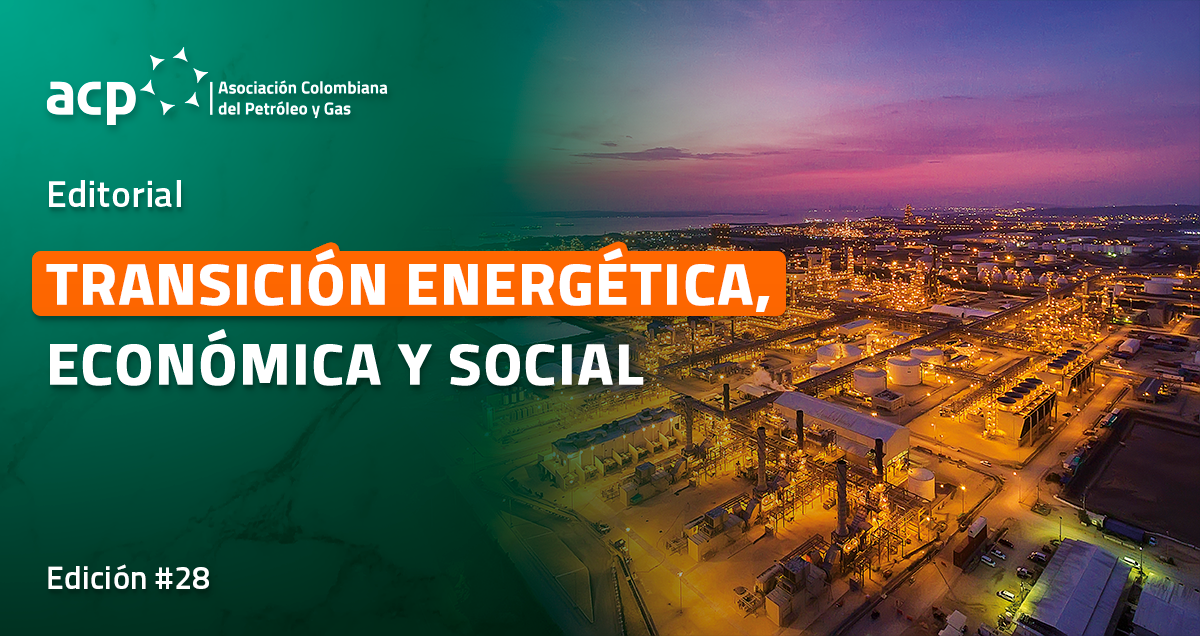
In the midst of the search for a fair energy transition, which is still not fully defined in the world, the country must think in terms of energy self-sufficiency and a transition that serves Colombia.
Frank Pearl
Executive President of the Colombian Association of Oil and Gas – ACP
Two months after assuming the presidency of the Colombian Association of Oil and Gas (ACP), I thank the affiliates for their trust and value the work of Francisco Lloreda, on which we will continue to advance in our contribution to sustainable development and the energy transition of the sector and Colombia.
Oil and gas have been a pillar of the development of modern societies. The transition to other energy sources will be gradual. According to the International Energy Agency (IEA), the world will continue to demand hydrocarbons for the next decades, and according to its projections, the peak demand will occur in 2030. From that year on, its share within the energy supply decreases, even though the volumes remain at relevant levels.
From this industry, we will continue to promote respectful and joint work among the Government, the State, communities in the regions, stakeholders, academia, and large, medium, and small businesses, so that in the coming decades, Colombia transforms into a modern economy, a pillar of a prosperous and peaceful contemporary society.
Colombia is not immune to this trend; according to the National Energy Plan 2022-2052 (PEN), some energy prospecting scenarios foresee significant increases in consumption until 2032. Energy sovereignty, national sovereignty, and the modernization of the economic system go hand in hand. Therefore, in the midst of the search for a fair energy transition, which is still not fully defined in the world, the country must think in terms of energy self-sufficiency and a transition that serves Colombia, that is, a “Colombian-style” transition.
The marginal cost curves for abatement in Colombia show a likely scenario of gradual transition, in which resources from the sector can be used to achieve three purposes: energy transition, economic transition, and social transition.
The energy sector is advancing in the transition. We call on the sectors of the economy that generate the highest greenhouse gas (GHG) emissions and consume the most energy and water to join this agenda, co-lead the transition, and become pillars of a sustainable economy that values the wealth of our ecosystems and closes current social and economic gaps.
Colombia's economic transition, that is, the formalization and modernization of the economy; the significant increase in wealth and per capita income, in today's country, will be possible if we increase and make the best use of hydrocarbon reserves and strengthen its entire value chain, including the distribution segment, which is a major generator of formal employment. This economic transition has one purpose: to achieve social transition, that is, the eradication of poverty and the consolidation of a large, robust, and wealthy middle class, whose capacity for consumption, saving, and investment does not depend on state subsidies or terms of trade.
In a country with poverty levels above 40 percent, with nearly seven million people who do not consume basic nutrients daily, with approximately four million people living in misery and high levels of social conflict, it is essential to prioritize humanitarian and social issues. Therefore, the energy transition must prioritize resources to generate formal productive diversification in the regions, capillarity in the economic system, and formalization of local economies, considering the characteristics of the ecosystems where economic and social activities are developed.
The above implies a gradual implementation of the transition route, which allows for the generation of wealth and value in the regions and, in this way, advances in social transition. Thus, the three strategic initiatives: energy transition, economic transition, and social transition are interdependent. State policies must facilitate and promote simultaneous progress on all three fronts in the coming decades. It is essential to have a royalty system that moves away from hundreds of small projects with low impact capacity and becomes an effective tool for regional economic transformation. It is unacceptable that in Colombia we have regions that have received trillions of dollars in royalties, where the majority of their inhabitants still live in conditions of poverty and misery.
In order for the hydrocarbons sector to effectively contribute to achieving the country's objectives, it must have adequate market and profitability conditions, as well as security for its operations throughout the national territory.
In order for the hydrocarbons sector to effectively contribute to achieving the country's objectives mentioned above, it must have adequate market and profitability conditions, and security conditions for its operations throughout the national territory.
Colombia's economic transition, that is, the formalization and modernization of the economy; the significant increase in wealth and per capita income, in today's country, will be possible if we increase and make the best use of hydrocarbon reserves and strengthen its entire value chain, including the distribution segment which is a major generator of formal employment.
From this industry, we will continue to promote respectful and joint work among the Government, the State, communities in the regions, stakeholders, academia, and large, medium, and small businesses, so that in the coming decades, Colombia transforms into a modern economy, a pillar of a prosperous and peaceful contemporary society.
 Colombian Association of Oil and Gas