
Government authorities and the hydrocarbon sector sign an agreement to pave the road to Rubiales in Puerto Gaitán, Meta.
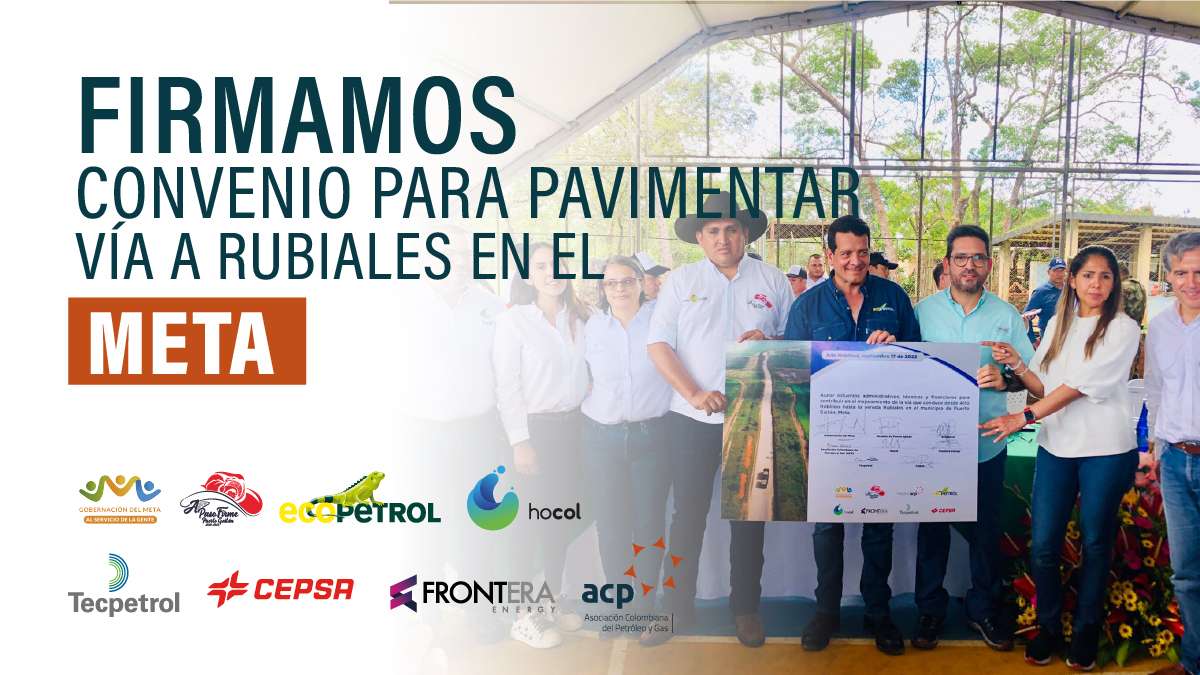
Ecopetrol, the Government of Meta, the Mayor's Office of Puerto Gaitán, the Colombian Association of Oil and Gas (ACP), Frontera Energy Colombia Corp, Tecpetrol Colombia S.A.S., Cepsa Colombia S.A. and Hocol S.A. signed a framework agreement to improve the conditions of the road that leads from Alto Neblinas to the Rubiales village in the municipality of Puerto Gaitán, Meta.
- The Government of Meta, the Mayor's Office of Puerto Gaitán, Ecopetrol, the Colombian Association of Oil and Gas (ACP), Frontera Energy Colombia, Tecpetrol Colombia, Cepsa Colombia, and Hocol S.A signed a framework agreement for the improvement of the Alto Neblinas – Rubiales road.
- The work will benefit more than 41 thousand inhabitants of the region.
This alliance will contribute to the socioeconomic development of the region and to boosting its energy, agricultural, and agro-industrial potential, fundamental for the strategic development of the Altillanura. The improvement of the road corridor, which will benefit more than 41 thousand inhabitants of Puerto Gaitán, is aligned with the municipal and departmental development plans; therefore, this agreement reaffirms the commitment of public and private entities to provide resources and technical and management capabilities to initiate the work.
For the intervention of the road corridor, which spans a length of 156 km, it will begin with the paving of up to 93 km in different sections with an approximate investment of $512 billion. The project will be executed in phases as studies and designs are completed, permits and authorizations from the competent companies are obtained, and resource availability is ensured by the entities.
Ecopetrol and private operators will contribute $284 billion, the municipal administration $28 billion, and another $200 billion will be managed by the Government of Meta and other public entities through other funding sources such as the General System of Royalties (SGR).
“Ecopetrol has the municipality of Puerto Gaitán at the center of its interests, and here we will materialize all efforts together with the oil industry, local authorities, and communities that will lead us together to walk the path of energy transition and realize the potential development of this region. Without a doubt, this road corridor contributes to this purpose,” said Felipe Bayón Pardo, president of Ecopetrol.
For his part, the governor of Meta, Juan Guillermo Zuluaga, stated, “I have no doubt, this is the most important cooperation agreement in Colombia between the hydrocarbon industry and municipal and departmental administrations. We already have the design studies for the first 40 kilometers and we made a delivery for review and adjustments to Ecopetrol for the next 40 kilometers, and we are also working on the structuring for another 20 kilometers.”.
“We know that one of the obstacles to the productive transformation of the regions is the poor state of road infrastructure; therefore, this commitment is fundamental for the oil and gas industry and reflects our interest in working jointly and in coordination with all actors in the regions to address the main needs of the communities, as well as to promote the economic diversification of the country,” expressed Silvana Habib, vice president of Operations and Sustainability of the ACP.
For the mayor of Puerto Gaitán, Jorge Plazas, “The start of this project is great news for the people of Puerto Gaitán, who have waited many years for a solution for the definitive improvement of the road to Rubiales. Without a doubt, this first effort will be very important to strengthen the development of a large area of our municipality, where not only oil is exploited but also dedicated to agricultural, livestock, and agro-industrial activities.».
The execution of the works will have oversight composed of municipal and departmental institutions, contributing companies, and communities, aiming to ensure that the project develops within the established timelines and under the defined technical, administrative, and financial requirements.
 Colombian Association of Oil and Gas