
All Colombians should feel proud of this industry without which our country would not be what it is today.
More than 100 years ago, we had already experienced the first energy transition. The happiest ones with the first oil wells, in 1859, must have been the whales, as oil was extracted from them for various purposes, especially for lighting lamps, and thanks to kerosene, they were no longer so hunted, although the joy for this distilled crude lasted little due to the electric bulb. Not only the large mammals must have celebrated: humans -including slaves-, horses, and oxen also did because their muscular strength was for centuries the main transforming source of energy.
It was only a matter of time before oil changed the world and our country. For Karl Benz to invent the first vehicle and Henry Ford to perfect and commercialize it, for Rockefeller to envision the potential of oil and found the Standard Oil Company, for the president of Colombia, Núñez, to order its search and the writer Jorge Isaacs to join the cause, and for Colonel José Joaquín Bohórquez to find oil in the Infantas area, with the misfortune that no one paid attention to the properties of his discovery, with one exception: the French-born businessman Roberto de Mares.
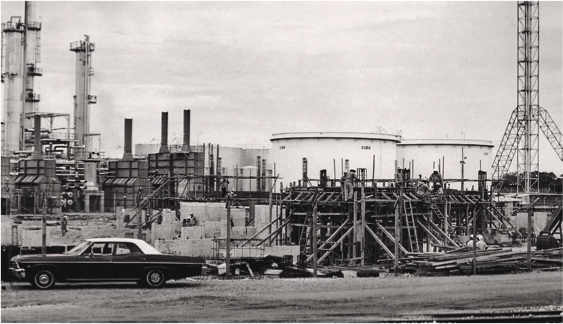
From there, the story is better known. De Mares signed a concession to operate the fields in Santander for 30 years, the Tropical Oil Company was established, later ceded to Standard Oil (known by its initials SO), which later became ESSO and today ExxonMobil, a pioneer of the industry in the country that last year celebrated a hundred years of believing in Colombia.
Thus, on April 29, 1918, the Infantas 2 Well began oil production with 42 barrels a day, forever changing the history of the country. One hundred years later, that loyal and long-lived field still produces an average of 44,000 barrels a day.
Gasoline was sold in cans, in pharmacies and commercial establishments. With the massification of the automobile, kiosks with pumps were built to supply gasoline to cars; today, Colombia consumes more than 280,000 barrels of liquid fuel daily. Between 1922 and 1928, 13,246 vehicles had been imported. It was the beginning of fuel distribution and the automotive industry. The country currently has 5,000 stations and 12 million vehicles -not counting motorcycles-, from school buses and ambulances to cargo and passenger vehicles, that move the country and its economy.
Something similar happened with aviation. Ten years after the Wright brothers made their first flight attempt, the first airplane arrived in Santa Marta in 1913, and in 1919 the first airline was created. The great rivers were used as takeoff and landing strips. In 1928, Lindbergh was received as a hero in Cartagena. Who would have thought that one hundred years later -with Jet fuel- the aviation industry in Colombia would mobilize 40 million passengers a year, interconnecting the country and it with the outside.
[prefix_blockquote cite=»Francisco José Lloreda, President ACP»]Oil and gas literally move the country, by land, rivers, sea, and air; and they provide resources to the State like no other economic activity.[/prefix_blockquote]
And a few years later, this transformative dynamic would reach the countryside, replacing horses and oxen. Today, the 50% of agricultural production units of 1,000 hectares or more use fuel-based machinery. The mechanization of agriculture allows Colombia to be fed. Soon, the volume of crude required several means of transportation. The four exclusive ships that moved the barrels along the Magdalena River were joined by the construction in 1926 of the first pipeline, 536 kilometers long, between Barrancabermeja and Mamonal on the Atlantic Coast; today we have a pipeline system of 9,000 kilometers, in addition to a transport capacity of 100,000 barrels through that same natural flow.
Colombia became an oil exporter: in 1927 it represented 17% of exports; the third producer in Latin America and the eighth worldwide.
On August 25, 1951, on the occasion of the reversion of the Mares Concession, Ecopetrol was born, our great company. The National University of Medellín and the Industrial University of Santander began to prepare professionals for the industry. Today the country has five faculties of petroleum engineering and eleven of geology, which allow us to have more than 11,000 engineers and 5,000 geologists at the service of Colombia. This does not include electrical, mechanical, electromechanical, civil engineers, among others, as well as environmental engineers, sociologists, anthropologists, political scientists, psychologists, and lawyers who work in the sector.
After the discovery in La Cira-Infantas, we had those of Chuchupa-Ballena, Caño-Limón, Cusiana-Cupiagua, and the rediscovery of Rubiales. All of them developed or operated by foreign companies that have contributed their knowledge and capital to boost the oil and gas industry in the country. Today we have more than 50 operating companies from 15 countries betting on Colombia offshore, enhanced recovery, new basins, and that are ready to develop unconventional deposits. In addition, there are more than 150 specialized goods and services companies, not counting those contracted at the regional level, that boost the economy of the producing areas.
This account has a purpose: to remind us -to raise awareness- of the importance that the hydrocarbon industry has had in the development of the country. Colombia would not be what it is today without this industry. Oil and gas literally move the country, by land, rivers, sea, and air; they provide electrical reliability to industries and homes, allow the countryside to be more productive, and contribute resources to the State like no other economic activity. It is hard to imagine an economic sector, a good or a service, a daily activity, that does not have a relationship with hydrocarbons -as input, as means, or final product-. That is why all Colombians should feel proud of this industry -target of vituperation, misinformation, and ill will-, without which Colombia would not be what it is today.
One hundred years building the country! A century that gives us serene authority to tell Colombia, here is your hydrocarbon industry and we are going for another hundred years.
 Colombian Association of Oil and Gas