
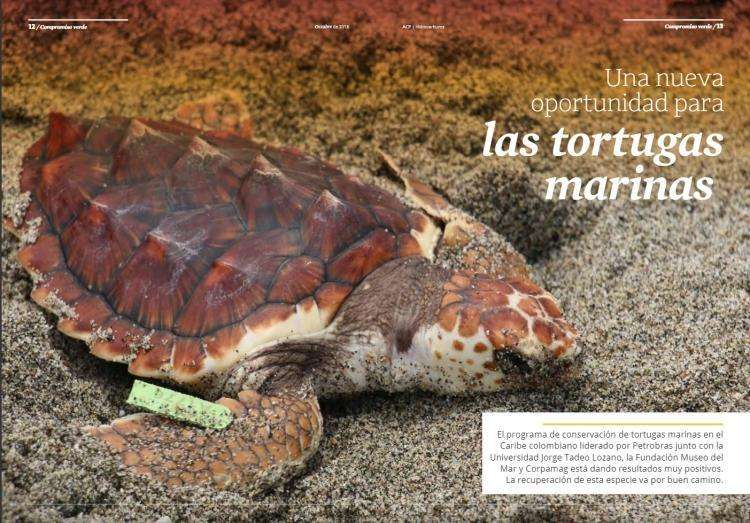
The sea turtle conservation program in the Colombian Caribbean led by Petrobras together with Jorge Tadeo Lozano University, the Museum of the Sea Foundation, and Corpamag is yielding very positive results. The recovery of this species is on the right track.
Sea turtles are on the red list of threatened species worldwide, and in the Colombian Caribbean, four of the seven species that exist in the world nest. Their threat is not only due to the deterioration of their natural habitat but also because they are frequently targeted by artisanal fishing.
Petrobras in Colombia has a significant operational participation in the offshore segment and maintains a strong commitment to the environment globally. “One of Petrobras” initiatives as a corporation is the protection of biodiversity in the environments where we operate. We make this investment in Colombia voluntarily, out of goodwill and in line with our values,” explains Rodrigo Valle Real.
Twelve years ago, an alliance was formed between Petrobras, Jorge Tadeo Lozano University, the Museum of the Sea Foundation, and Corpamag (Regional Autonomous Corporation of Magdalena) to combine efforts in the conservation and stabilization of sea turtles in the Colombian Caribbean. This initiative mirrors the conservation project called TAMAR, carried out by the company in Brazil for over 35 years.
Conserving sea turtles is not an easy task. Therefore, initially, and thanks to the knowledge of experts from Jorge Tadeo Lozano University and the Museum of the Sea Foundation, conservation strategies were determined, including, for example, knowledge on how to collect and incubate the eggs, care for the hatchlings, and the proper feeding of the turtles until they reach a safe age for their return to the sea.
“All this aimed at increasing the probability that they reach adulthood and improving their reproduction rate, which leads to stabilizing the population of the species,” says Claudia Patricia Alarcón, Social Responsibility leader at Petrobras.
The fundamental process is in the community. Therefore, the program includes an education strategy that encompasses associations of fishermen, schools and colleges in the department, as well as tourists visiting the area along with diving schools and their local activities. One of the most important spaces for dissemination and awareness is the facilities of the Marine World Aquarium in Rodadero, Santa Marta, where visitors learn about the turtles and their importance to the ecosystem.
The program, which takes 12 months for each cycle, has three phases. The first is the identification of nesting beaches and their monitoring day and night to detect nests and collect the eggs (or to make an enclosure around them). The second is the care of the eggs during incubation, which today reaches a success rate of 80% in hatching. And the third phase – the longest, as it takes about eight months – is the raising of the newborns, including their feeding with different diets as they grow, and controlling their environment to mimic the conditions they will find in the sea.
Each cycle culminates with a day of introducing the turtles to their natural environment, which has become a traditional event in the area. In 2018, more than 500 turtles returned to the sea with a higher probability of reaching their adult and reproductive age. On April 28 and 29, on the beaches of the Magdalena department, more than a thousand people participated, including local fishermen, children with their families, tourists, volunteers, scientists, and journalists who covered the news.
[prefix_blockquote align=»right» pull=»yes» italic=»yes»]The program includes an education strategy that encompasses associations of fishermen, schools and colleges in the department, as well as tourists visiting the area.[/prefix_blockquote]
The introduction event is considered one of the most important moments of the program, as it is a valuable opportunity to raise awareness in the community about the importance of reducing indiscriminate fishing and the consumption of these species. “It is not an individual effort by the scientists. Fishermen participate in the collection of the eggs, local children help with the care of the turtles, and finally, the community gathers to introduce them to their habitat,” explains Rodrigo.
Throughout the project, more than 3,000 juveniles from the rearing process and 13,000 newly hatched neonates have been introduced into the natural environment, which contributes to the repopulation of the species. In fact, the results have been surprising: not only has the number of turtles arriving at the beaches of Magdalena to nest significantly increased, but nesting has also recently been reported in the southwest of Santa Marta, something that hadn't happened in 30 years; and after a long time, specimens of Leatherback and Hawksbill turtles were seen again.
Another relevant result is that the message is also resonating within the community, and the proof is that the number of reports from locals about turtle sightings has increased, whether related to those nesting or those accidentally caught in fishing nets.
“We have learned their names, what kind of turtles they are, and what differences they have among them. I have seen how they are being conserved and helped to reach a size where they can defend themselves,” says Julio, a local fisherman. “I feel excited when I have them in the basket; sometimes I cry seeing so many that I used to sacrifice to sell, and today I feel happy with the work we are doing.”.
[prefix_blockquote align=»left» pull=»yes» italic=»yes»]In 12 years, more than 16,000 turtles have been returned to their natural environment, all with a high possibility of reaching their reproductive age, which contributes to repopulation in the Caribbean.[/prefix_blockquote]
Additionally, the project has a component for generating and disseminating scientific knowledge about turtles: seven theses related to the program have been developed, five research seminars, 15 international events, and 14 national events, all of which are complemented by research in areas such as photo ID, geometric morphometry, molecular biology, ethology, and satellite telemetry.
Another very relevant achievement in the research framework is the introduction of eight specimens, both juveniles and adults, with satellite transmitters that allow tracking their movements throughout the Caribbean and thus identifying their migratory routes and areas for mating, nesting, and feeding. “One of them was even tracked beyond Cuba,” says Rodrigo.
“Year after year, our knowledge and our technique for collecting, raising, feeding, releasing, and tracking turtles evolve. There is a significant effort due to Petrobras's interest in the conservation of ecosystems,” concludes the Petrobras representative.
 Colombian Association of Oil and Gas