
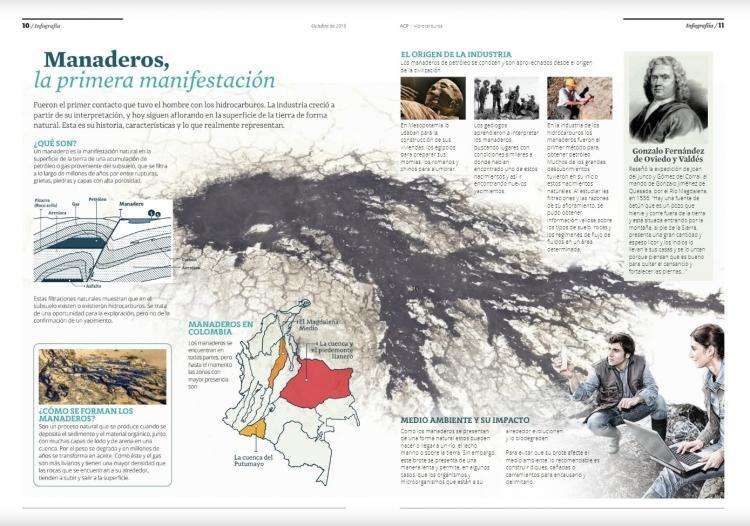
They were the first contact that man had with hydrocarbons. The industry grew from their interpretation, and today they continue to surface naturally on the earth. This is their history, characteristics, and what they really represent.
WHAT ARE THEY?
A seep is the natural manifestation on the surface of the earth of an accumulation of oil or gas from the subsurface, which filters through fractures, cracks, stones, and layers with high porosity over millions of years. These natural seepages show that hydrocarbons exist or existed in the subsurface. It is an opportunity for exploration, but not a confirmation of a reservoir.
HOW ARE SEEPS FORMED?
They are a natural process that occurs when sediment and organic material are deposited, along with many layers of mud and sand in a basin. Due to the weight, it degrades and over millions of years transforms into oil. Since oil and gas are lighter and have a higher density than the surrounding rocks, they tend to rise and come to the surface.
THE ORIGIN OF THE INDUSTRY
Oil seeps have been known and utilized since the dawn of civilization.
- In Mesopotamia, they used it for the construction of their homes, the Egyptians for preparing their mummies, and the Romans and Chinese for lighting.
- Geologists learned to interpret seeps by searching for places with similar conditions where they had found one of these origins, thus discovering new reservoirs.
- In the hydrocarbon industry, seeps were the first method to obtain oil. Many of the major discoveries initially had these natural origins. By studying the seepages and the reasons for their emergence, valuable information about soil types, rocks, and fluid flow regimes in a specific area could be obtained.
ENVIRONMENT AND ITS IMPACT
Since seeps occur naturally, they can emerge or reach a river, the seabed, or land. However, this emergence occurs slowly and allows, in some cases, the organisms and microorganisms around it to evolve and biodegrade it. To prevent its emergence from affecting the environment, it is advisable to build dikes, channels, or enclosures to direct and delimit it.
 Colombian Association of Oil and Gas