
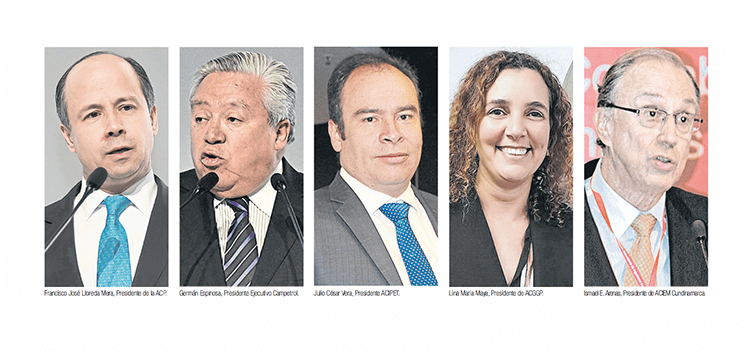
In the framework of the I Oil and Gas Summit, «100 years driving the development of Colombia,» the Presidents of the guilds that make up the Oil Guild Committee, organizers of the event, spoke about their vision for the future of the hydrocarbon sector, the lessons learned from the first century, and the challenges the industry will face in the coming decades.
«After a hundred years of history and experience in the hydrocarbon industry, Colombia has the opportunity to leverage the lessons this century has taught us and continue turning the wealth of the subsoil into progress for the territories and the country. Today, this industry is in a position to contribute in the next four years, $100 billion in taxes, royalties, dividends, and economic rights. To achieve this, investments of $7 billion dollars per year are required, which will only come if crucial decisions are made, such as reforming the general royalty system, ensuring legal security, having competitive regulation in transportation tariffs, gradually and comprehensively advancing in the liberalization of the fuel market, among others. In the coming decades, the country will face an energy transition, and the industry is not alien to that discussion; however, we know that fossil fuels, especially gas, will be with us for a long time, ensuring energy security and contributing to the progress of the country and the regions.». Francisco José Lloreda Mera, President of the Colombian Petroleum Association (ACP)
«We must work together, government, industry, and territory, to grow and demonstrate that we have the conviction, knowledge, and technology to operate always with strict environmental care and alongside social inclusion and sustainable regional development. Together, we are capable of generating shared value, caring for our natural resources, and ensuring opportunities for the people. Hydrocarbons have been the engine of the country for 100 years and must continue to be so for many more years, for its regions, inhabitants, and even for the orderly energy transition we must undertake. The decisions we make involve our energy security and the well-being of producing territories; that is why we see the need for unity, dialogue, and evidence-based decision-making to succeed.». Germán Espinosa, Executive President of Campetrol.
«Colombia has a golden opportunity in the different potentialities of the sector and it is to continue making oil and gas a source of sustainable development for all Colombians. If we adequately leverage the potential we have in conventional and unconventional deposits, offshore operations, enhanced recovery, crude oil, and gas, we can ensure that our hydrocarbon sector continues to generate social and economic development for all Colombians; that it remains an important and added value for the Colombian economy and even aims to advance towards a productive transformation to not depend on the extractive industry.». Julio César Vera, President of ACIPET
«The development of the hydrocarbon sector is directly related to knowledge, as long as expert professionals share their knowledge in the appropriate forums like the one being held this week, society will have the technical foundations that allow us to make the best decisions to discover and develop the potential of the Colombian subsoil. The priority for all professionals in the Oil and Gas Industry is to continue the development of our industry based on respect for the environment and society, in which the revenues associated with the industry translate into benefits that allow for the sustainable development of our country. Even in the face of the uncertainties generated by the fluctuation of oil prices and the limited resources we have, the guild has expectations; the existing resources combined with alternative energy sources present us with a long-term challenge whose only goal is sustainability.». Lina María Maya, President of ACGGP.
«In light of the temporary rebound in international oil prices, it is time for Ecopetrol and other companies in the sector to direct their Exploration and Production activities towards the development of projects of a magnitude commensurate with the country's potential. This requires designing and promoting business schemes that allow the involvement of medium and small investors for smaller projects, services, and technology, among other aspects, so that exploratory and production activities are fully deployed in all areas with the aim of incorporating new reserves and new investments in companies interested in expanding the industry. Likewise, the recovery of oil prices is an opportunity for petroleum, civil, electrical, mechanical, electromechanical, and electronic engineers, among others, to rejoin the industry to support exploration and exploitation activities of crude oil and in key tasks of construction, operation, and maintenance of a fundamental asset for the social and economic well-being of the country. The above also poses the challenge of training and updating engineers in new techniques and technologies that the industry is using in its production processes, such as in the case of Unconventional Reservoirs, a bet that will give the country greater opportunities to increase its oil reserves and to involve new human resources in this scenario.» lng. Ismael E. Arenas, President of ACIEM Cundinamarca.
 Colombian Association of Oil and Gas