
One of the most relevant contributions made by the hydrocarbon industry to the country is its participation in the nation's revenues. These revenues come from income tax payments, dividends from Ecopetrol, and economic rights resulting from contracts with the National Hydrocarbons Agency. Since 2012, the sector has contributed nearly $75 billion, which represents an average of 15% of the central government's revenues, making the industry the largest contributor to the country's fiscal income.
[prefix_blockquote font=»1″ cite=»ACP» align=»right» pull=»yes» italic=»yes»]The hydrocarbon sector is considered one of the engines of the national economy. The industry's contributions include the payment of tax obligations to the Central Government, the payment of royalties intended for regional investments, and the development of social investment projects aimed at closing socio-economic gaps and promoting sustainable development in the regions. Social investment, largely linked to the development plans of departments and municipalities, represents an important source of resources and capacity for executing key projects to improve the quality of life of the inhabitants in the regions where the industry operates.[/prefix_blockquote] In addition to these contributions, the industry also pays royalties that have amounted to resources of $35 billion, which have been a source of financing for investment projects in regions across the Colombian territory. However, the industry's contribution is not limited to the payment of its tax obligations. Indeed, each year companies allocate resources for the development of social investment projects in the areas of operation, according to the needs identified by communities and local authorities.
In fact, within the framework of the implementation of the peace agreement, new opportunities arise for social investment made by companies in the territory. In the post-conflict context, the National Government has created a series of instruments and mechanisms for the involvement of the private sector in financing projects that support and promote social development in those areas most affected by the conflict, known as ZOMAC. These areas, which consist of 344 municipalities, have been prioritized due to their low levels of socio-economic development and high levels of victimization due to the armed conflict.
Through specific legislation, the Government has provided a series of instruments and mechanisms such as Works for Taxes, the Territorial Focus Development Plans (PDET), or the Plan/Paz Contracts. Some of these initiatives will be financed through the Peace Fund, with contributions from multilateral entities and cooperating governments, offering the sector the opportunity to leverage resources for financing and executing projects in the prioritized areas. In this context, the industry has the opportunity not only to engage in programs and projects led by the National Government and obtain tax benefits but also, and even more importantly, to contribute from its knowledge of the territory, improve its local relationships, and be part of the implementation of peace in Colombia.
In this context, it is necessary to highlight that companies make two types of social investment. The first type is contractual social investment that arises from the execution of what is defined in Annex F of the exploration and production contracts that promote the development of Community Benefit Programs (PBC). This type of investment also includes social-focused projects established in the environmental license. Due to its contractual and regulatory nature, this investment is termed “mandatory.”.
The second type is voluntary social investment, which in turn is divided into social investment made directly by companies and leveraged investment that arises from resource management and the development of projects in which companies are one of the contributors, in addition to other additional sources of resources.

In the period between 2012 and 2016, companies invested approximately $2.6 billion in social investment projects within the framework of the development of Community Benefit Programs (PBC), the environmental license, and Corporate Social Responsibility (CSR) programs.
These investments have become a source of financing for projects aimed at improving the quality of life of communities, generating productive linkages, improving education levels, and promoting sustainable development in the areas of operation of the sector. Thus, 92% of the indicated projects were aligned with local and departmental development plans, mainly focusing on community strengthening, education, productive projects, housing, as well as culture, recreation, and sports.
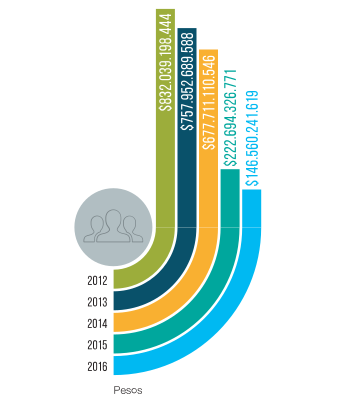
In general terms, and as can be seen in graph 6, despite the decrease in social investment amounts accompanied by the drop in oil prices, the industry has allocated a greater proportion of resources voluntarily. Indeed, more than $2 billion has been designated to investment programs that respond to the needs and demands of communities in the areas of operation and that are aligned with local development plans. The remaining $561 billion corresponds to contractual investment.
Now, upon reviewing the figures for 2016 in detail, social investment amounts exceeded $147 billion. While this figure is lower compared to previous years, it is necessary to highlight the efforts made by companies to fulfill commitments made with communities and focus investment on those projects with the greatest social impact. Undoubtedly, the slowdown in sector activity and the consequences of falling prices led companies to make budget adjustments that resulted in a decrease in the social investment budget.
Of the total $147 billion in social investment executed in 2016, most are part of the voluntary investment led by companies or leveraged with third parties. 67% of the resources, $99 billion, were voluntarily allocated by companies to strengthen the social progress of communities. 33% of the remaining resources, $48 billion, are part of the contractual commitment that companies must fulfill under the E&P Contracts or environmental licensing processes.
 Colombian Association of Oil and Gas
