
One of the main causes of conflict in the operational areas of the sector arises from the expectations that communities have to link themselves labor-wise to the industry. Specifically, 43% of the blockades against hydrocarbon activities are related to labor issues, despite the significant levels of labor linkage that companies achieve each year.
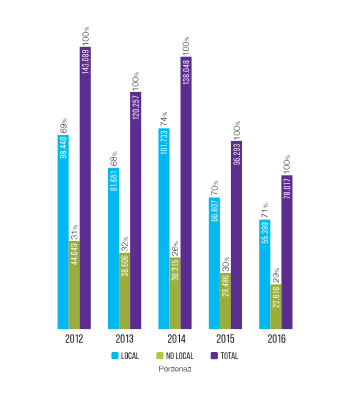
According to the information that has been presented annually in the Social Management Report published by the ACP, (see graph 2), it is evident that in the last five years (2012 – 2016), 70% of the linked workforce, on average, is local labor. Continuing the trend of previous years, in 2016, of the 78 thousand linked, 71% (55,399) lived in the rural and urban areas adjacent to the companies' activities.
Although there is a decrease of 11,408 linked compared to 2015 and 46,334 compared to 2014, companies have focused on linking a greater proportion of local labor, both skilled and unskilled. This is due not only to the regulatory guidelines of the Ministry of Labor but also to the various efforts that companies have made to train, certify, and promote the labor formalization of communities, which allows them to have the necessary personnel in the areas neighboring the operations.
Likewise, it is evident that of the 55,399 linked, 54% is skilled labor and the remaining 46% is unskilled labor. As in previous years, the largest number of linkages is for positions that require not only experience but also certain qualifications in order to ensure the safety of operations. This has involved, as mentioned earlier, the development of training programs for communities to develop the knowledge and skills required to take on the sector's tasks, which, in addition to generating local hiring, has increased the regional competitiveness of the workforce.
 Colombian Association of Oil and Gas
