
[prefix_blockquote font=»1» cite=»ACP» align=»right» pull=»yes» italic=»yes"]The industry remains committed to the local development of the regions in which it operates. Through the linking of local labor, economic chains are generated that energize development in rural and urban areas, where there has been little institutional presence from the National Government.[/prefix_blockquote] According to the report from the United Nations Organization in Colombia on the sustainable development goals in the country, presented in 2015 (Sustainable Development Goals, Colombia, tool for approaching the local context), one of the main factors for overcoming poverty and local development is the generation of job opportunities for the urban and rural population of the regions in Colombia.
According to the business policies of the hydrocarbons sector, companies engaged in exploration, production, and transportation of oil seek to generate job opportunities for stakeholders in the areas of operation. In this way, companies have become one of the main drivers of local economies.
Although this industry is not labor-intensive, undoubtedly, the job opportunities generated in the areas of operation create linkages that mobilize local economies. However, the decrease in oil prices that began in 2014 had negative effects on job creation, despite companies' efforts to maintain levels of labor hiring.
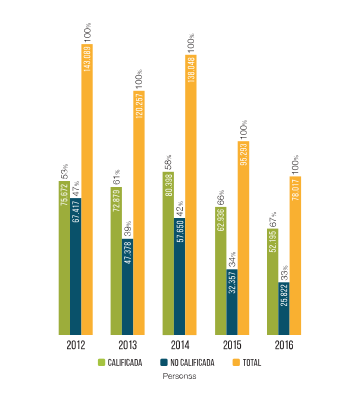
As can be seen in Graph 1, since 2014, the year in which there was a significant decrease in international oil prices, there was also a decrease in the percentage of labor hiring. According to information collected by the ACP, through the Social Management Report, in these three years there has been a decrease of almost 44% in labor hiring, which is partly due to the decrease in exploration activities, in which a high percentage of labor linkage is generated.
However, during 2016, companies in the sector hired almost 80 thousand people across the country. As in previous years, the majority of employees were skilled labor, due to the type of activities carried out in this industry, which require skilled labor with some type of specific studies. Specifically, 67% (52,195) of the employees have technical, technological, professional, postgraduate studies, or some type of certification. Of these 52 thousand employees, 57% reside in the areas of operation. On the other hand, 33% of the linked labor is unskilled (25,822), and of this, 100% corresponds to exploration and production activities residing in the areas of operation, complying with regulations.
Indeed, the regulations for labor management in the sector, defined in Decree 1668 of 2016 from the Ministry of Labor, establish that 100% of unskilled labor and 30% of skilled labor must be hired locally. It should be noted that this regulation does not apply to transportation activities, but there are significant efforts to promote local hiring in these areas. Likewise, this regulation establishes that hiring must be done through authorized providers with the aim of dismantling illegal intermediation.
In this sense, and according to the information provided by the companies, the sector is complying with regulatory requirements; however, in favor of transparency and accountability, it is necessary for the Ministry of Labor to define procedures that allow for an objective understanding of compliance with the regulation.
 Colombian Association of Oil and Gas
