
Since the beginning of the decline in oil prices, 2016 was the year in which the price reached its lowest levels of the last decade. This drop, in addition to generating a reduction in state resources, contracted the dynamics of hydrocarbon activity.
In 2016, the industry contributed to the Central Government $2.6 trillion derived from income tax payments, dividends from Ecopetrol, and economic rights from contracts with the National Hydrocarbons Agency (ANH). Despite being the sector that contributes the most to the Central Government, this year saw a reduction of 64% compared to the contributions of 2015 and 87% compared to 2014. Regarding royalties, in 2016 resources of $4 trillion were generated, which represented a decrease of 24% compared to the previous year.
The impact of falling prices on the dynamics of the sector was also evident. According to the results of the investment study conducted by the ACP[1], 2016 was the second consecutive year in which there was a decline in sector investment. Specifically, exploration decreased by 10% compared to 2015 and 60% compared to 2014; investment for the development of exploratory activity was close to USD $790 million; that is, 11% less than in 2015. Only 25 wells were drilled, and seismic activity focused mainly on offshore activity with an equivalent of 36 thousand kilometers.
Specifically, there was a decrease in production levels, due to the need to prioritize the less expensive barrels. In 2016, the average production figure was 888 thousand barrels per day (the lowest figure since 2010), while in 2015 this figure exceeded one million barrels. Additionally, as a consequence of this dynamic, 75 production fields were closed in 2016.
One of the greatest impacts resulting from this slowdown in sector activity is evident in the operating territories. As will be observed throughout this report, the figures for employment, social investment, road infrastructure, goods, and services are the lowest since 2010, which has implied a slowdown in regional economies.
[prefix_calltoaction title=»See more information here:» title_color=»#d66700» button_text=»Consult» button_link=»https://acp.com.co/web2017/es/asustos/economicos/129-informe-economico-no-12-tendencias-inversion-ep-2016/file.html» target=»blank» button_background=“#d15000”]
Due to this context, the relationship with stakeholders, the viability of operations, and the social environment situation have become the main challenges for the sector. Indeed, the reduction of royalties related not only to the change in the General Royalty System (SGR) but also to the reduction of production by the sector, combined with the decrease in the hiring of local labor and the increase in the supply of goods and services, have generated an increase in social conflict and, on some occasions, heightened the animosity and discontent of communities.
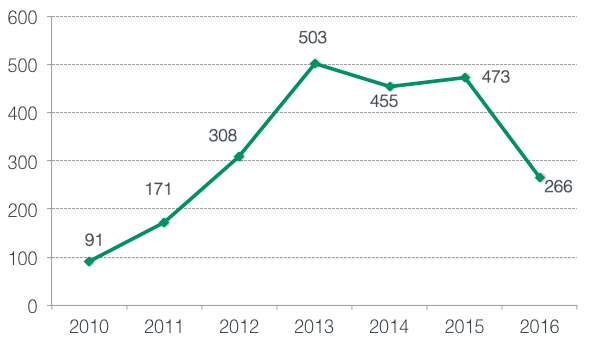
Blockades to the Industry 2010 – 2016
Source ACP.
Although, in numerical terms, in 2016 there were fewer blockades to operations compared to previous years, it is necessary to consider that this is also due to the decrease in activities. However, despite being a year with fewer acts of fact, these were characterized by having greater complexity in their management, and on several occasions their duration increased and therefore, the impact on activities.
Indeed, according to a study conducted by the ACP[1] (based on the municipal typologies index of the DNP) it shows that oil municipalities compared to non-oil municipalities have higher levels of institutional and economic development, better fiscal performance, and better quality of life. It is highlighted that oil municipalities have higher revenues derived from tax collection, better employment conditions, better execution of the transfers from the General Participation System (SGP), and the 70% of the variables of the Multidimensional Poverty Index (IPM) behave more favorably than in non-oil municipalities. For example, there is evidence of an improvement in housing conditions, access to public services, fewer barriers to accessing health services, higher levels of education, less illiteracy, less school absenteeism, and less child labor.
Despite the above, in many cases, the perception in the operational areas seems to be different. This is partly related to the fact that expectations have been created about the role of companies in the territory, which, with the drop in prices, have not been able to be fulfilled. In particular, and as the figures in this report confirm, job opportunities and the hiring of goods and services at the regional level have decreased.
On the other hand, detractors of the sector, in a new political context, have created a discourse that emphasizes a supposed negative impact on the environment and social aspects, derived from the activities. In this situation, the industry, under the current scenario of the operational regions, faces the challenge of seeking alternatives that, in addition to strengthening relationships with stakeholders and communities, enable their operations in such a way that the contributions and benefits derived from the activity are not only more visible but also generate a long-term impact in the territories where the companies in the sector operate.
[prefix_calltoaction title=»See more information here:» title_color=»#d66700″ button_text=»Consult» button_link=»https://acp.com.co/web2017/es/?option=com_sppagebuilder&view=page&id=32″ target=»blank» button_background=»#d15000″]
In this sense, the ACP and the industry are working on the implementation of a regional strategy that allows addressing the main concerns in the territory by showing and demonstrating the positive impacts that this sector has created. This will require continuous presence, constant information delivery, and a dialogue of equals with the communities.
Likewise, in close coordination with the operating companies, the National Government has also implemented a series of practices that strengthen the institutional presence of the sector in the territories. Among others, the Territorial Strategy for Equitable and Sustainable Management of the Hydrocarbons sector (ETH) seeks institutional articulation between the national and regional/local levels, through the development of dialogue spaces focused on providing information about the sector, boosting the capabilities of the territory, and promoting its sustainable development.
The industry remains committed, and the figures collected in this Report prove it, to making a substantial contribution to the development of the regions where it operates. There is full awareness that the viability of operations depends on continuing to improve the living conditions of the population in the operational areas.
 Colombian Association of Oil and Gas
